The Great Loop for Beginners: Route, Seasons, Boat Limits and Time
The Great Loop explained: the 6,000-mile route, which way to go and when, the bridge and draft limits your boat has to fit, and how long it takes.

The Great Loop is a continuous boat route around the eastern half of North America. You leave from any point on it, follow the water all the way around, and finish when you reach your starting point again. Loopers call that "crossing your wake". This guide covers the route, the seasons, the limits your boat has to fit, how long it takes, and how to pick a boat.
What is the Great Loop?
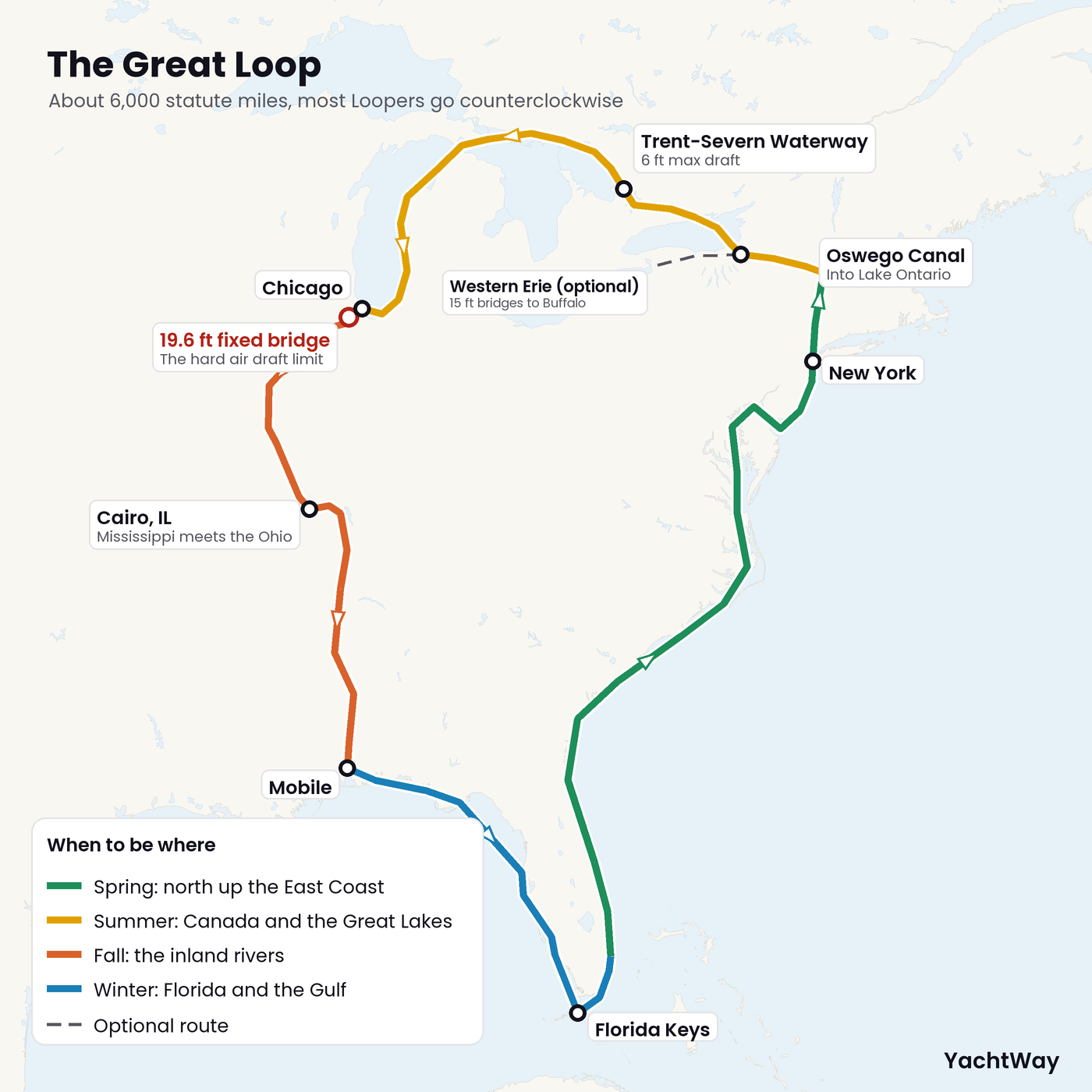
The route links the Atlantic Intracoastal Waterway, the Hudson River, the Erie Canal or Canadian canals, the Great Lakes, the inland rivers down to the Gulf of Mexico, and the Florida coast. It runs about 6,000 statute miles. The shortest version is about 5,250. Most routes cross into Canada, and one option stays inside the United States.
Boaters who finish the Loop can fly a gold burgee from the Loop cruisers' association. Members fly the white one until then.
Which direction and when
Most Loopers go counterclockwise and follow the weather:
Timing matters in the north. The northern locks close for winter, so you need to be through the canals and the Great Lakes before they shut.
The limits your boat has to fit
Air draft: 19.6 ftThe hard limit. Your boat must clear 19.6 ft to finish the Loop: a fixed bridge on the Illinois Waterway near Chicago with no way around it. Two optional routes are lower, the Chicago River at 17 ft and the western Erie Canal at 15 ft. Taller boats skip them by taking the Calumet River and turning off the Erie Canal at Oswego into Lake Ontario.Draft: 5 ft maxThe Rideau Canal is maintained at 5 ft and the Trent-Severn at 6 ft. The Atlantic Intracoastal gets hard above 5 ft at low tide.Length: No set limitThe Trent-Severn takes boats up to 84 ft.Beam: Locks onlyCheck lock widths on the canal routes you plan to use.
Air draft is the one that ends trips. Measure your own boat from the waterline to its highest fixed point, then check every bridge on your route against that height in YachtWay Waters, free with a YachtWay account. It shows tides, bridges and marinas on one map.
How long it takes
A typical Looper covers about 50 miles on a travel day and cruises about one day in three. The traditional trip takes about a year, and some crews take many years. The fastest runs, in fast boats with two drivers running day and night, have finished in under 12 days. That is a race, not a cruise.
How many locks
There is no official count, because it depends on your route. Crews who finished report between 101 and 192 locks.
Choosing a boat
Many trawlers fit both the bridge and the draft limits. Our trawler guide for the Great Loop lists 17 models that draw 5 ft or less, with how many are for sale now and the median asking price, from about $65k for a Mainship Pilot 30 II to about $710k for a Beneteau Swift Trawler 41 Fly.
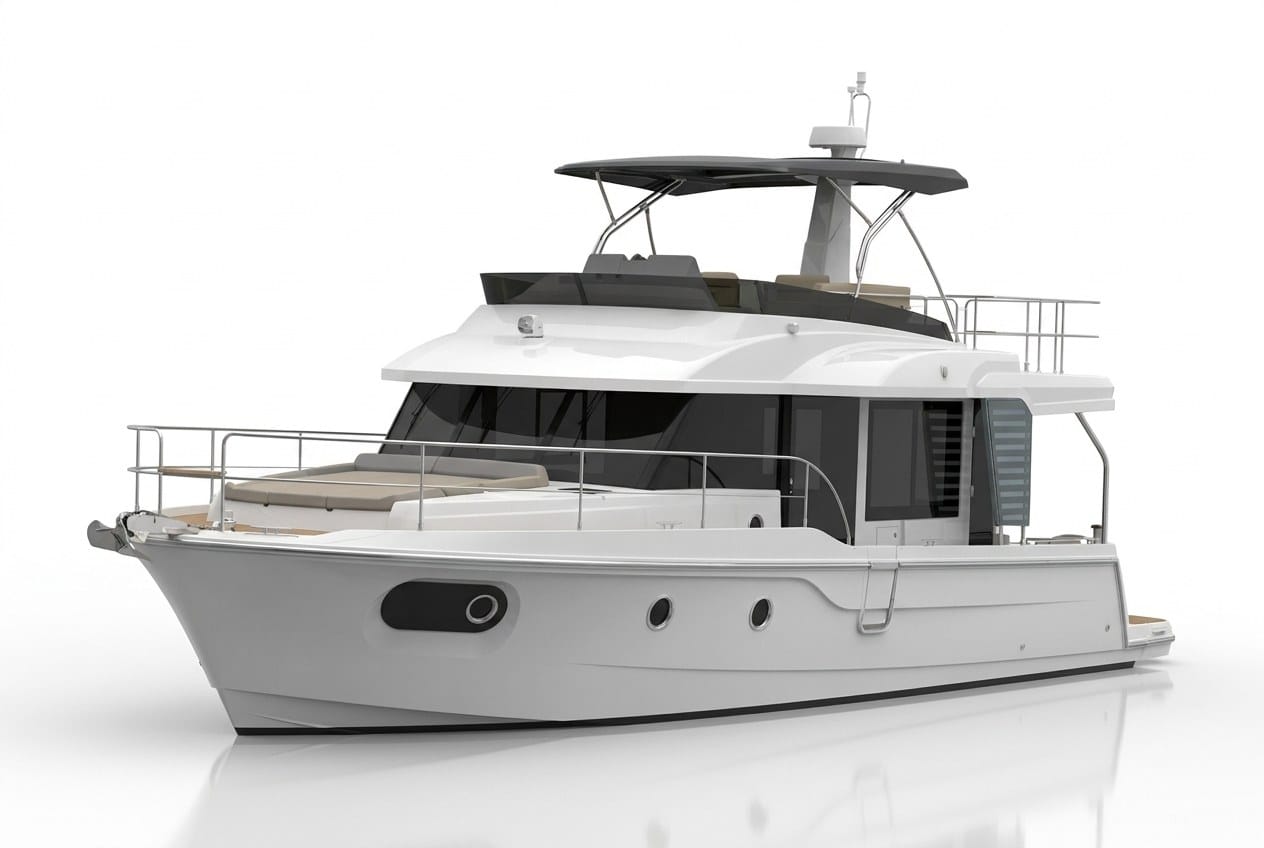
You can browse every trawler for sale on YachtWay and filter by length and price.
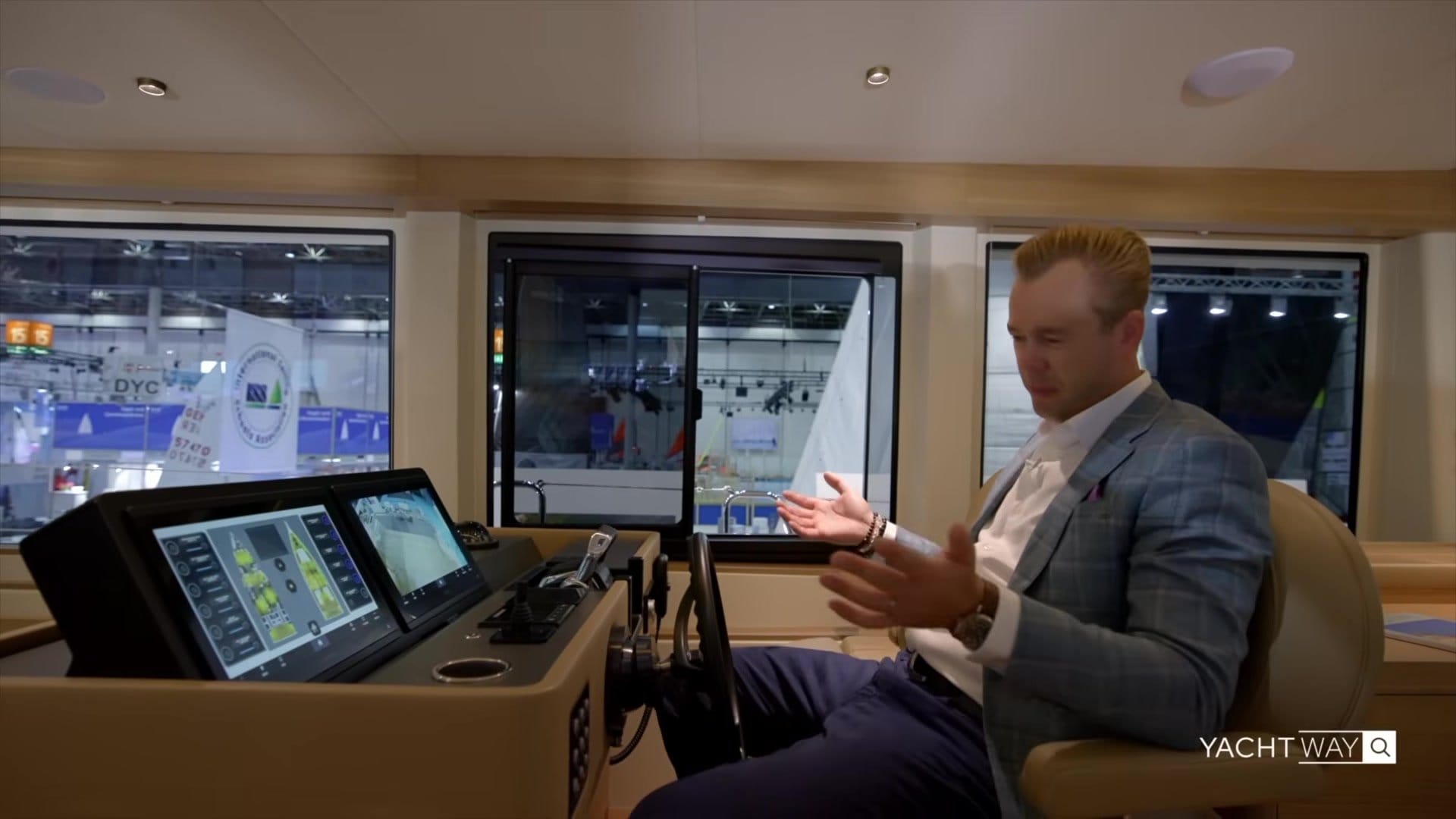
For a bigger shallow-draft trawler, Heigo Paartalu walked through the Omikron OT60 in a YachtWay Spotlight review. It draws about 2.8 ft. Check its air draft against the 19.6 ft bridge before you plan a Loop.
10 things to bring on the Loop
- A VHF radio, plus a waterproof handheld. You talk to every lockmaster and bridge tender on VHF, and a handheld lets you do it from the deck while locking through.
- Extra fenders, in two sets. One set for rough lock walls, a second clean set for tying up alongside other boats.
- Bow, stern and spring lines ready for locks. Rig them before you enter. Never tie off hard to a lock wall, because the water level moves fast.
- A depth sounder you trust. Several stretches sit right at 5 ft.
- An EPIRB or PLB. The Loop has several open-water crossings, including the Gulf.
- US and Canadian charts. NOAA charts cover US waters. Ontario needs Canadian Hydrographic Service charts. Keep electronic charts stored on the device, not streamed.
- Cruising guides. For anchorages, fuel stops and marinas along each leg.
- Passports or NEXUS cards for everyone aboard. You report to Canadian border services when you enter Canadian waters.
- The CBP ROAM app, set up before you leave Canada. It is how most boaters report back into the US. Check your saved profiles before you cross, because users report data going missing.
- Your measured air draft, written at the helm. Then check it against every bridge on the next leg in YachtWay Waters.
What it costs
There is no official cost figure. The biggest numbers are the boat itself, fuel, marina nights and maintenance, and all of them depend on the boat you choose and how often you stay in marinas. Start with the boat price in the trawler guide and build the rest of your budget from your own fuel burn and marina plans.
Great Loop fun facts
- Nobody knows who did it first. The Loop only became possible in 1848, when the Illinois and Michigan Canal linked Lake Michigan to the Mississippi and joined up with the Erie Canal.
- Nobody built it. The Loop was never one project. It strings together canals, rivers and coastal waterways that federal and state governments already maintain.
- The cruisers' association started with 14 members, signed up at a trawler show in Melbourne, Florida, in April 1999.
- Any size goes. The Loop has been done in everything from a dinghy to a 100 ft yacht.
- Do it twice and the burgee changes again. One finish earns gold, two earns platinum.
- The solo speed run was done in a 16 ft jon boat with a 60 hp outboard: 19 days and 13 hours.
- The fastest crewed run took 11 days and 21 hours in a rigid inflatable, in September 2026, with two drivers rotating day and night.
- Lock counts vary by route. Crews who finished report anywhere from 101 to 192 locks.
Share your Loop story
Have you done the Great Loop, or are you on it now? We would like to share your story with our readers. Email us at press@YachtWay.com.
Great Loop FAQ
How long is the Great Loop?
About 6,000 statute miles. The shortest route is about 5,250.
Which way do most people go?
Counterclockwise: north in spring and summer, south down the rivers in fall, Florida in winter.
What is the lowest bridge on the Great Loop?
The lowest fixed bridge you cannot avoid has 19.6 ft of clearance, on the Illinois Waterway near Chicago.
What draft can do the Great Loop?
5 ft or less is the safe number. Deeper boats run into trouble on the Rideau Canal and the Atlantic Intracoastal at low tide.
How long does the Great Loop take?
About a year is traditional. The fastest speed runs have finished in under 12 days, running day and night.