Nausicaä and the Courage to Jump: Inside Yusaku Maezawa's 114 Meter Lürssen
Where most yachts put a main saloon, Nausicaä puts a boy on a diving board, deciding whether to jump. Yusaku Maezawa spent 12 to 13 years taking that jump. Here is what he built, and what it says about thinking a decade ahead.


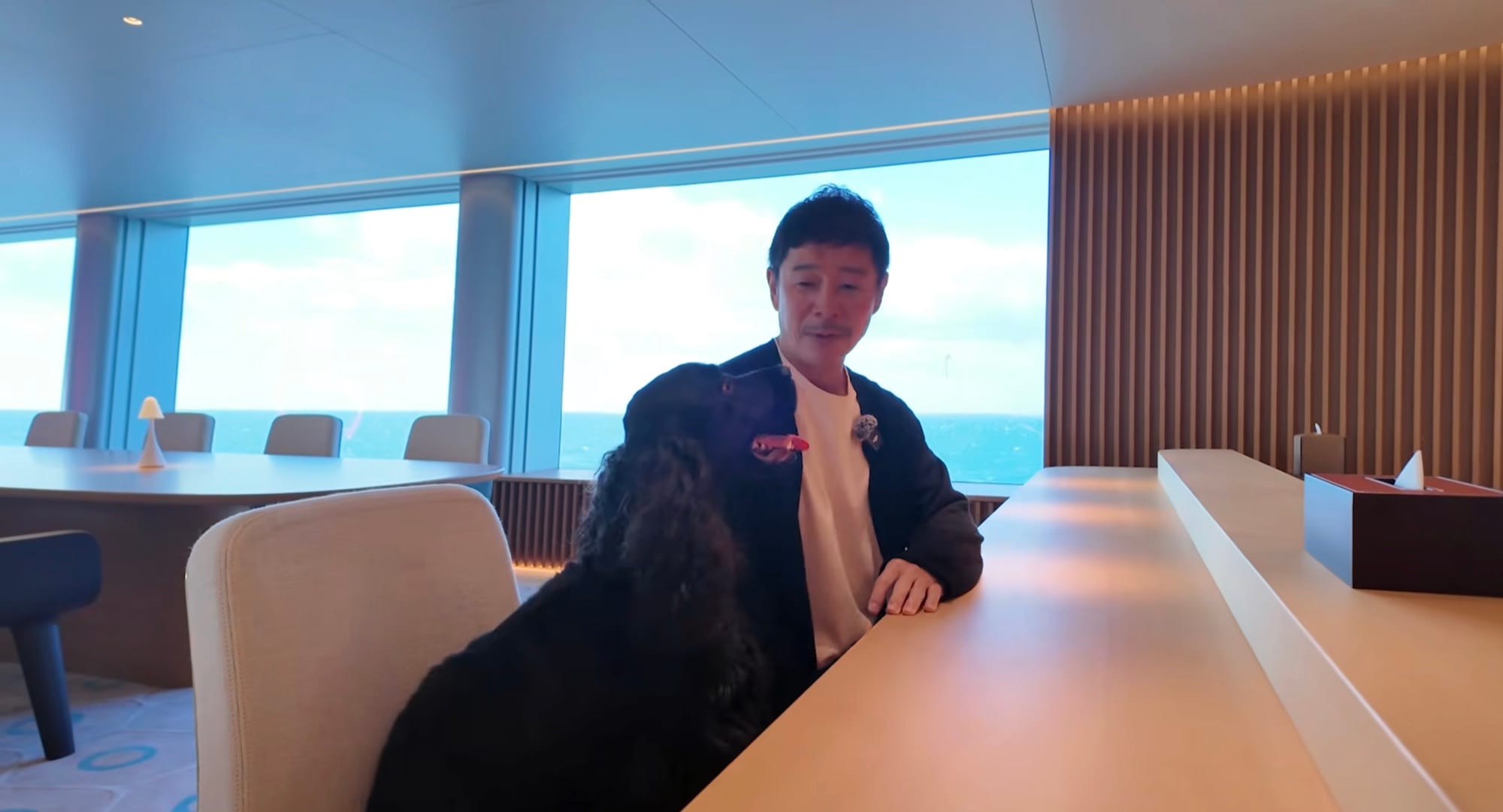
Nausicaä is a yacht about the courage to jump. Yusaku Maezawa's 114.2 meter (375 ft) Lürssen, designed by Marc Newson, took 12 to 13 years from first idea to open sea: about six years of planning and design, then about six years of construction, by his own count in a video tour published on YouTube on November 21, 2026. He started at 37 or 38. He is 50 now. Step inside and the idea becomes literal: where most yachts put a main saloon, Nausicaä has an art gallery, and at its center a boy sits on a diving board, deciding whether to jump.
Nausicaä at a glance
What does the Courage sculpture mean to Maezawa?
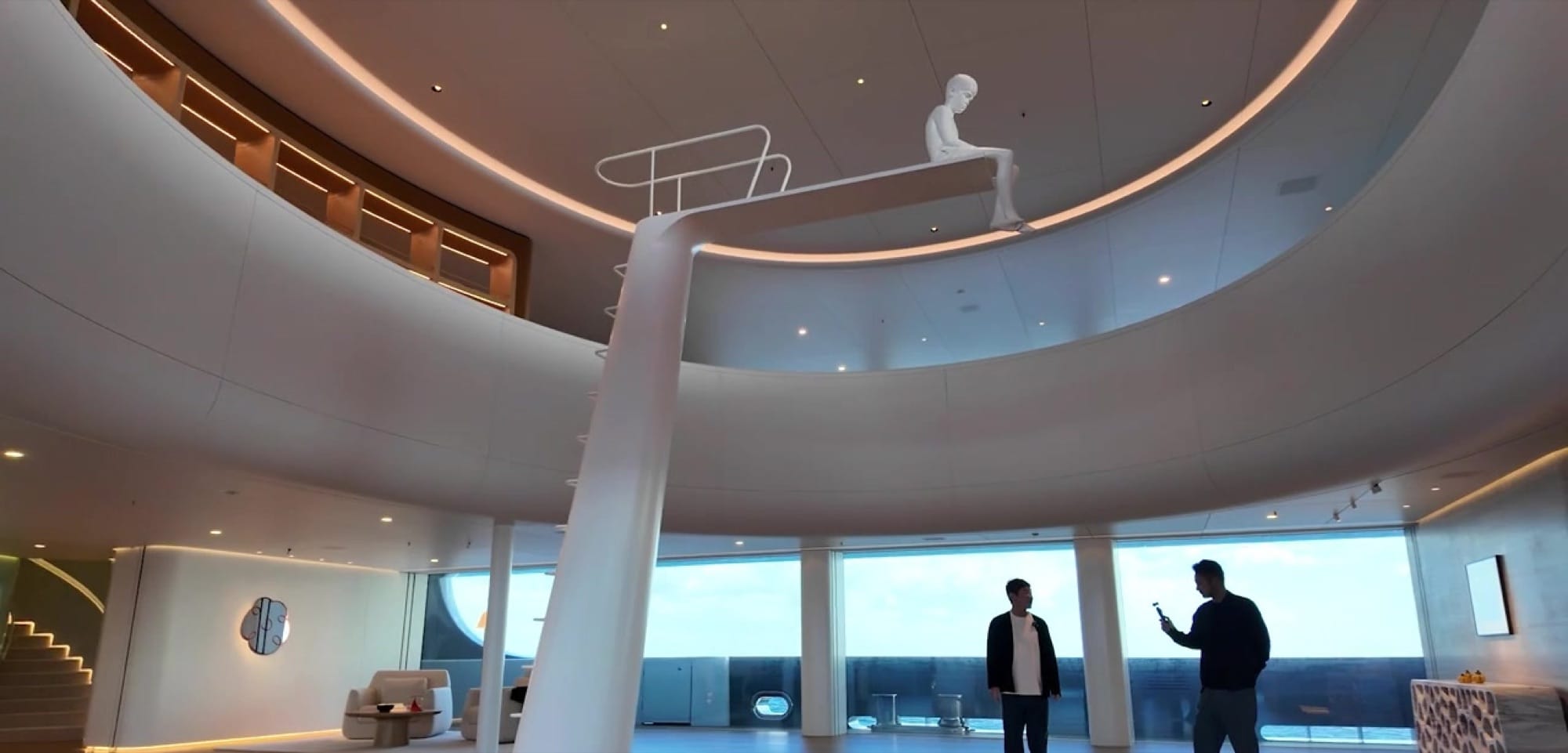
Courage is a portrait of the moment before a decision, and Maezawa says it is a portrait of himself as a boy. "When I was a kid, sometimes I found the courage to take a step," he says in the tour. "Other times, I gave up because I was scared. This piece reminds me of myself as a boy."
He asked Elmgreen & Dragset to make the piece for this yacht. It weighs about three tons and is secured to a steel plate hidden under the floor, so it can ride out the motion of the sea. It stands in a two-level gallery that, according to BOAT International, takes the place of a conventional main saloon. On a yacht that took more than a decade to build, the choice reads as a statement: the room every guest walks through is about deciding to go.

How long does it take to build a 114 meter yacht?
For Nausicaä, the answer was 12 to 13 years from first idea to open water. Maezawa says construction at Lürssen took about six years, and that planning and design had started about six years before that. Baird Maritime and boote report that the yacht was launched at Rendsburg in August 2025, went to sea trials from November 2025 and was delivered in May 2026.
That timeline is the part most people never see. A yacht of this size is designed for a life its owner can only imagine at the start. Maezawa began at 37 or 38 and stepped aboard at 50. Every choice made in planning, from the deck count to the art, had to still feel right more than a decade later.
What did Maezawa ask Marc Newson for?
Three things, Maezawa says: something unique, something soft, and something strong enough to go anywhere. First, a yacht nobody had seen before. Second, curves. "I've chartered lots of mega yachts before," he says. "Most look a bit like battleships, with sharp, pointed shapes." He wanted the opposite: "a soft, cute yacht with lots of curves," gentle because it is already so large. Third, range and strength. "I love adventure. I even went to space," he says, and he did not want rough seas or ice to keep him from any place.
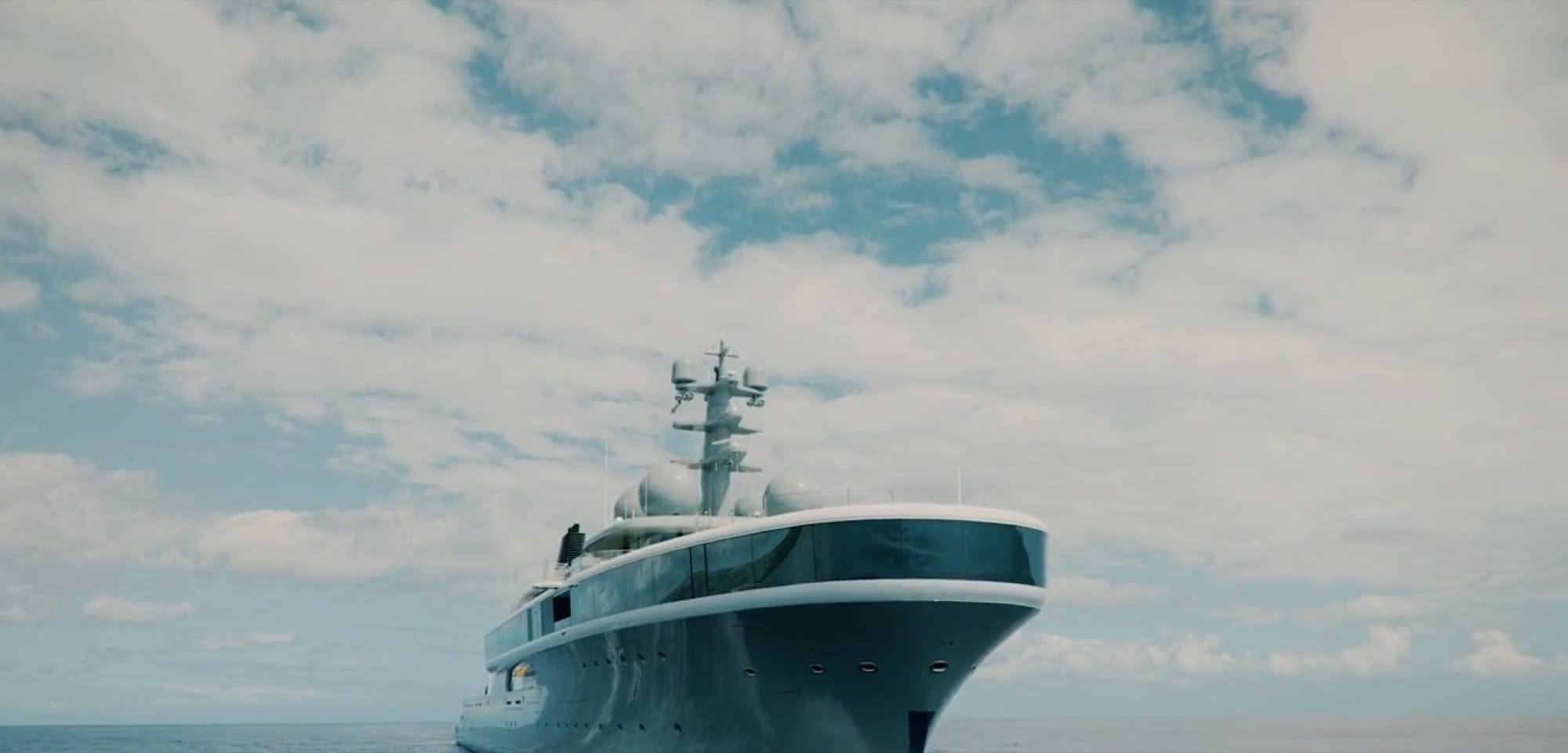
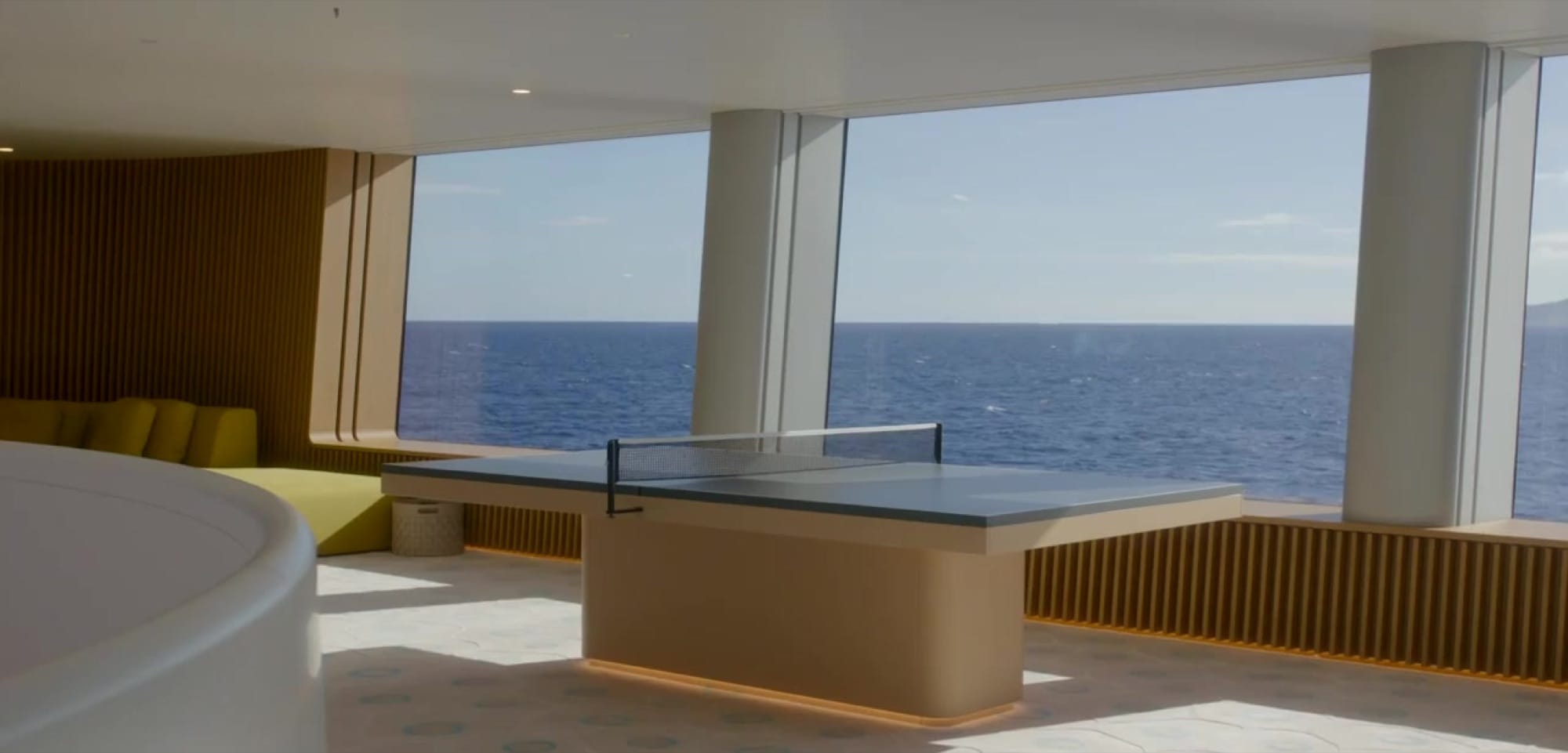
The split of work was clear. Maezawa chose the materials, the colors and the art. Newson did most of the design. Newson told BOAT International he wanted the yacht "big, beamy, purposeful, low and flat," and that when he suggested deleting an entire deck, Maezawa "was all for it." The result, in Maezawa's words on the tour, has "not a single sharp corner." The one exception he jokes about is the ping-pong table.
How does the art connect to the sea?
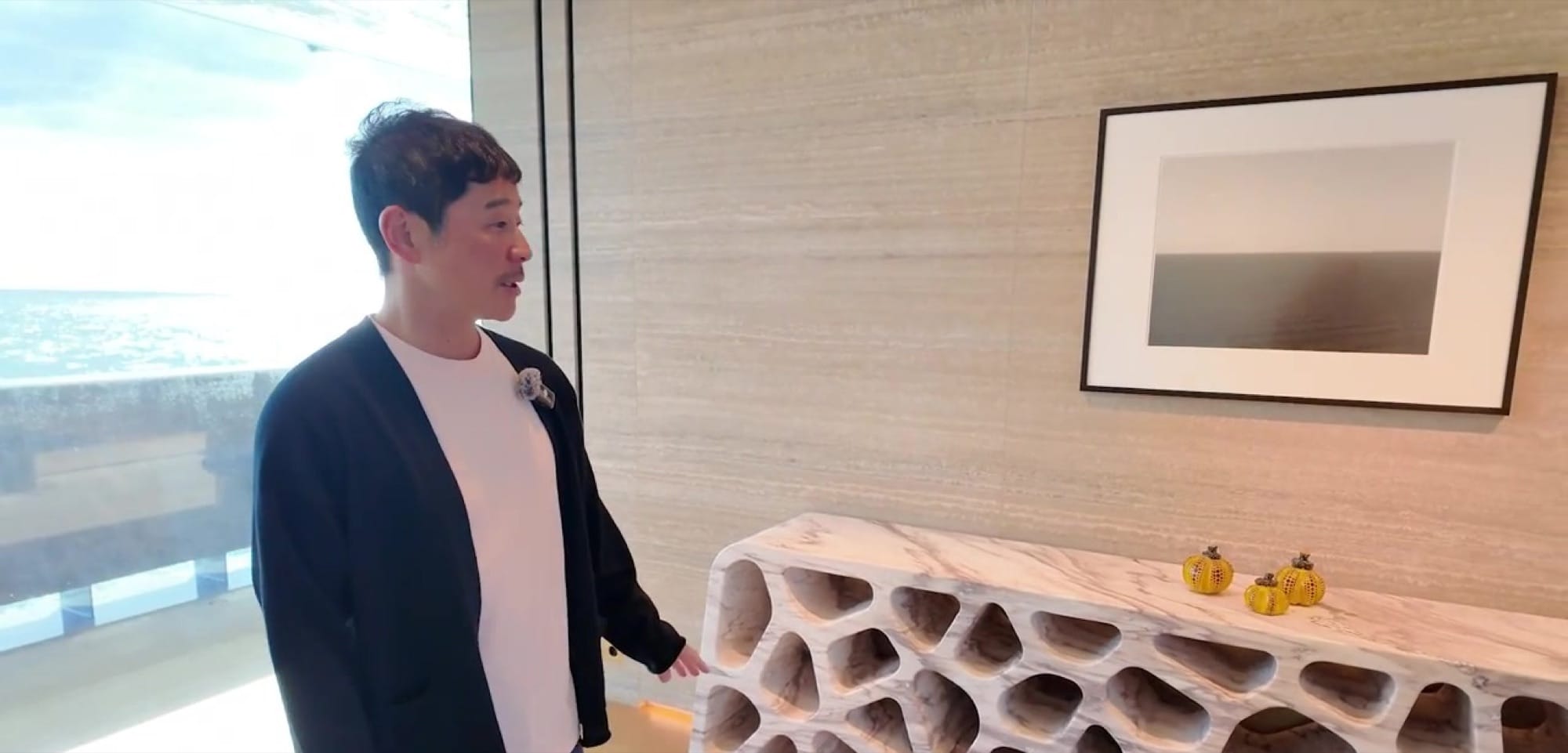
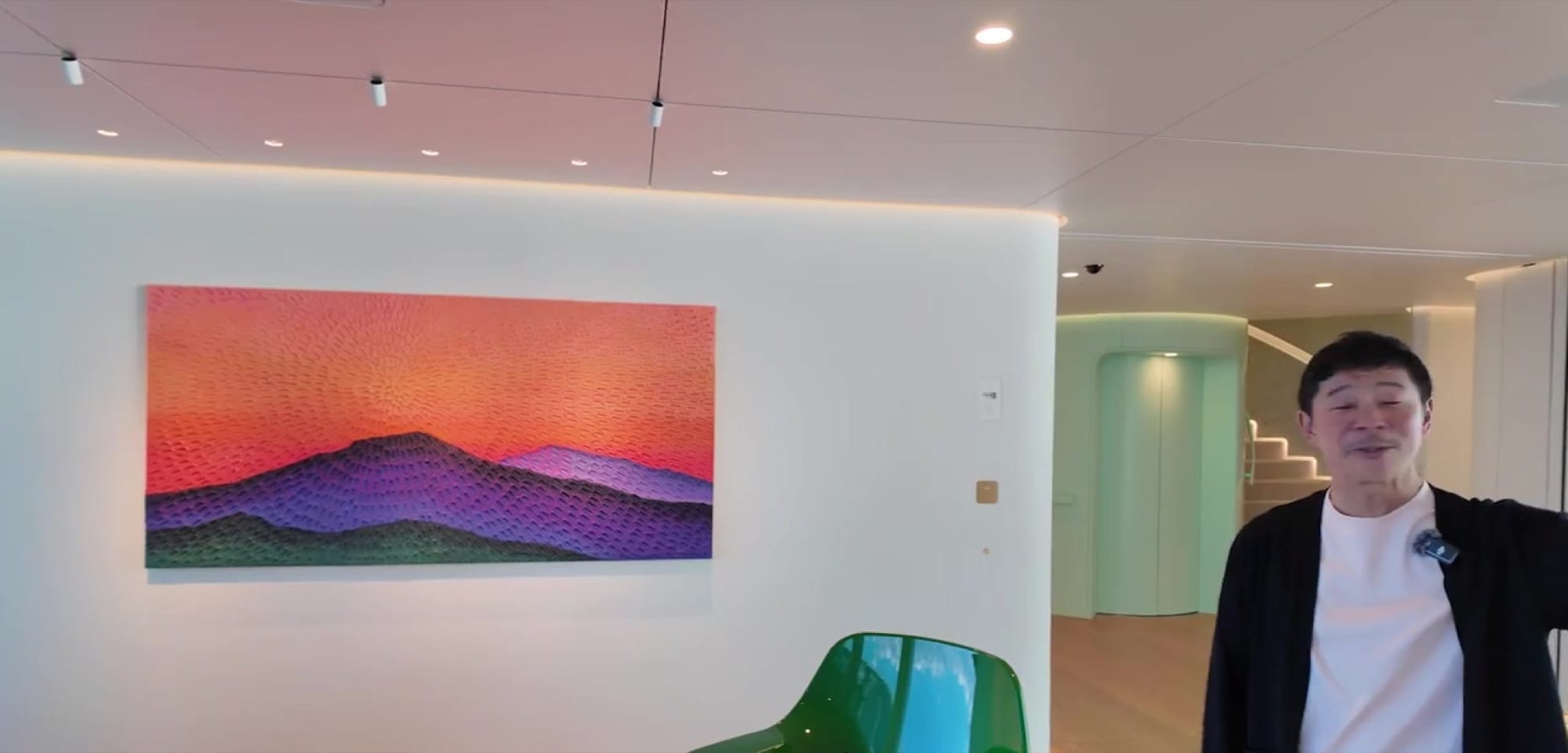
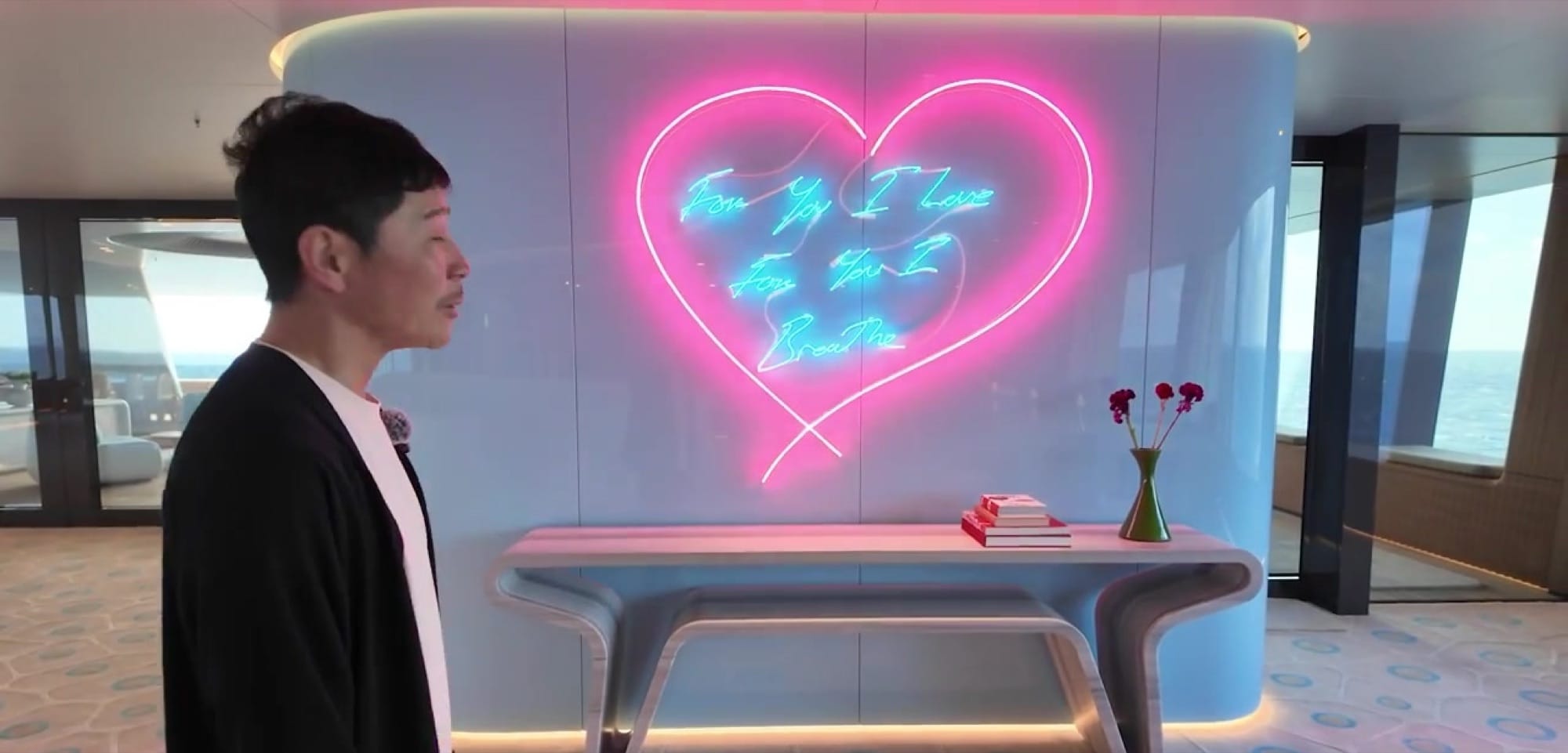
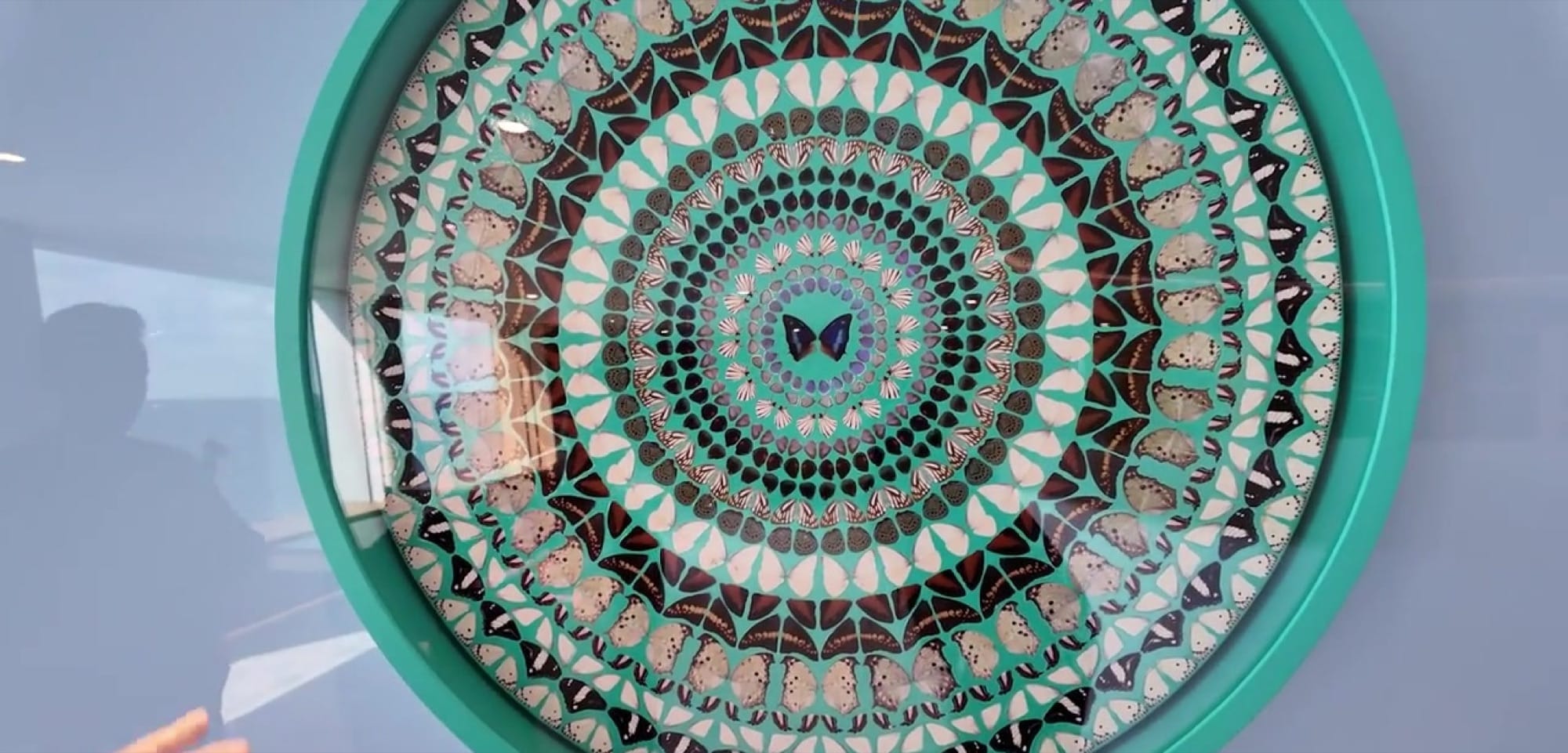
Most of the art was made or chosen for the boat, Maezawa says, and much of it looks outward. Hiroshi Sugimoto's Seascapes are hung so that the horizon in each photograph lines up almost exactly with the real horizon outside the window. The collection on board also includes a Yayoi Kusama pumpkin from 1985 and works by Jennifer Guidi, Tracey Emin, Damien Hirst and Jeff Koons. The point is the same as Courage: the art and the ocean are meant to be read together.
Why is the glass on Nausicaä so hard to build?
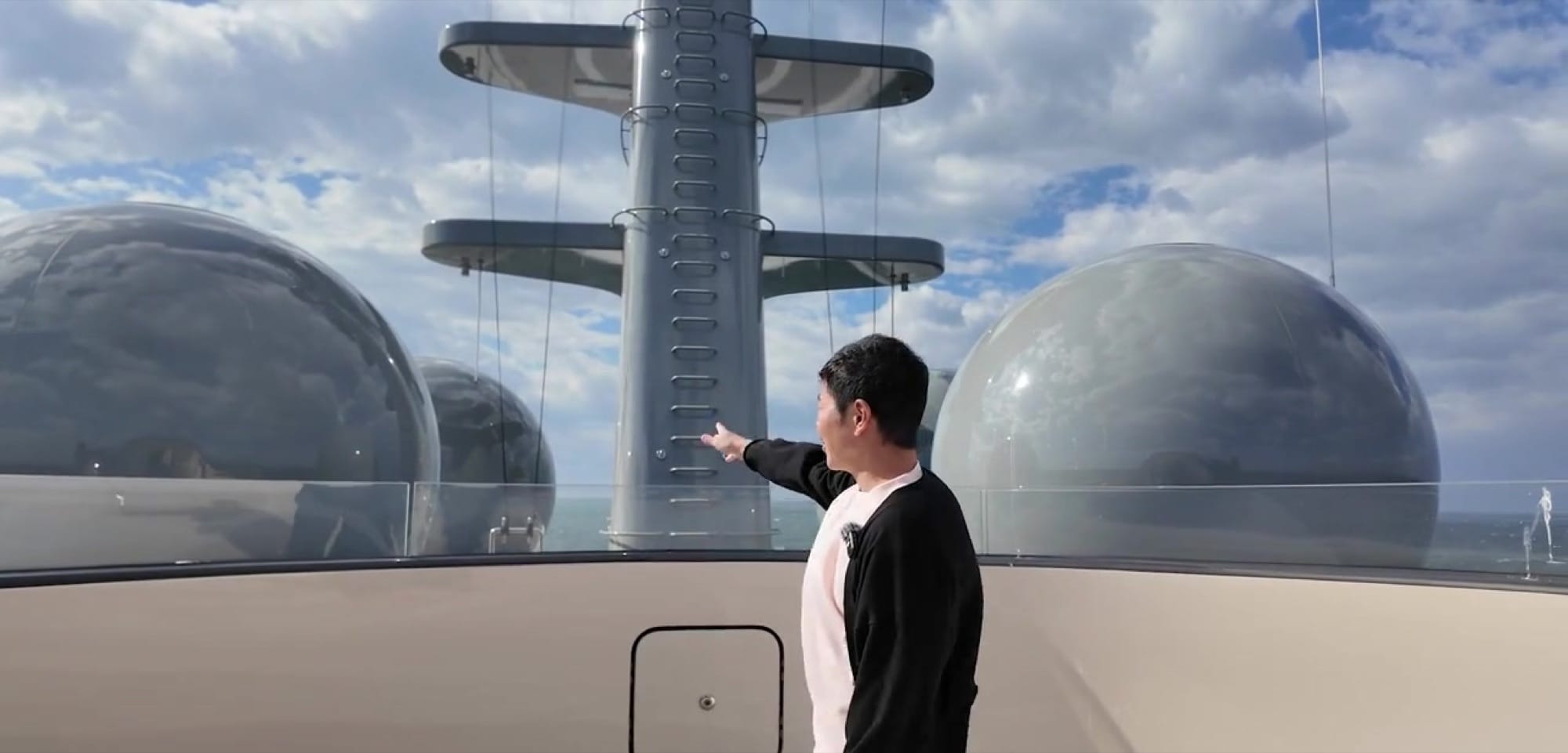
Because the biggest panes on Nausicaä are curved, and curved glass at this size fights back with distortion, bubbles and weight. The hardest piece sits on top: the dome over Maezawa's study. Per BOAT International, Lürssen's skydome uses seven panes, each 3,000 by 2,800 mm, 62 mm thick and 1,050 kg. Maezawa compares it to the glass in the front windows of a bullet train. "I heard a German company made it," he says in the tour. "Apparently they had to redo it over and over to get it right." Air bubbles can form while the glass is made, he explains, and "with a curved surface like this, things can look blurry or distorted."
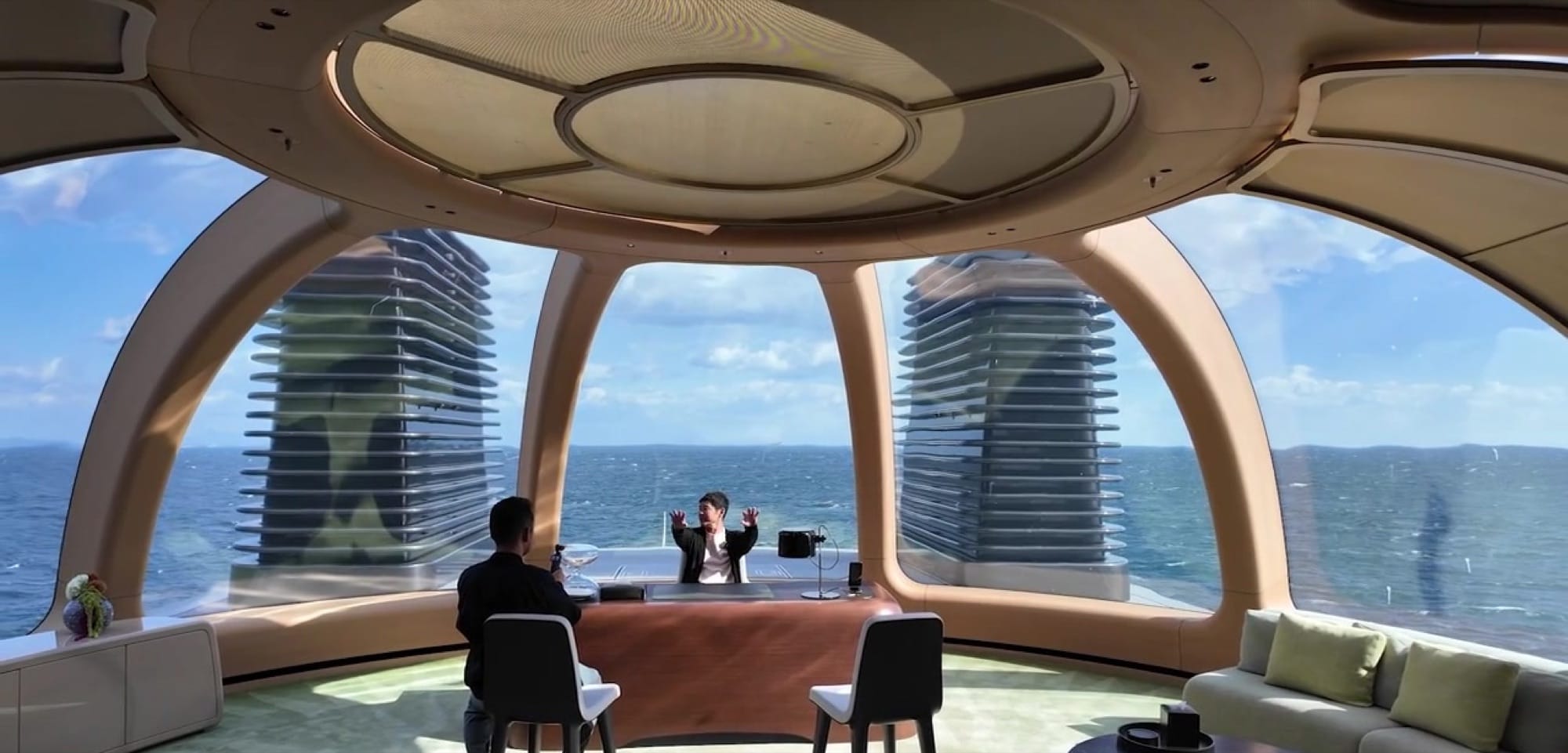
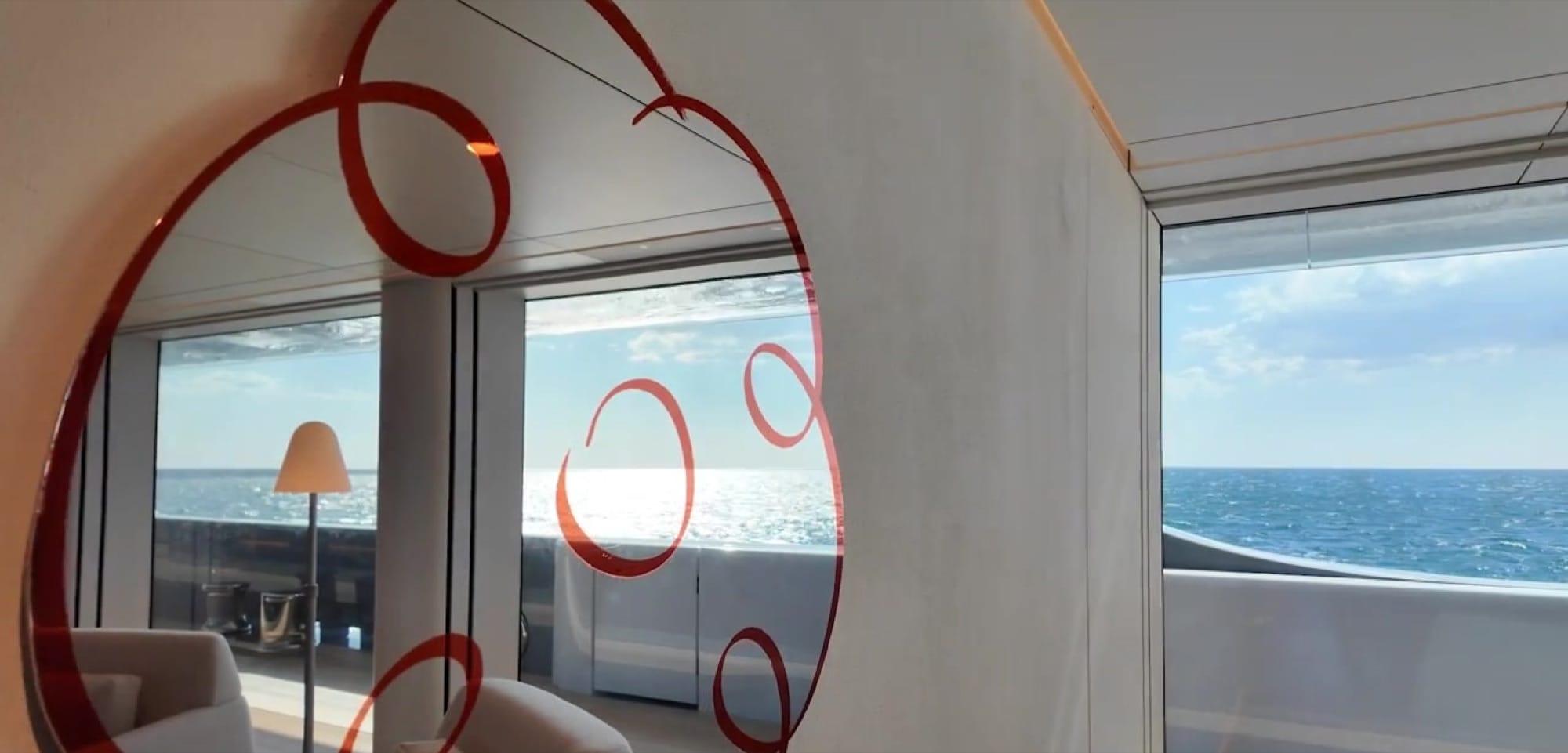
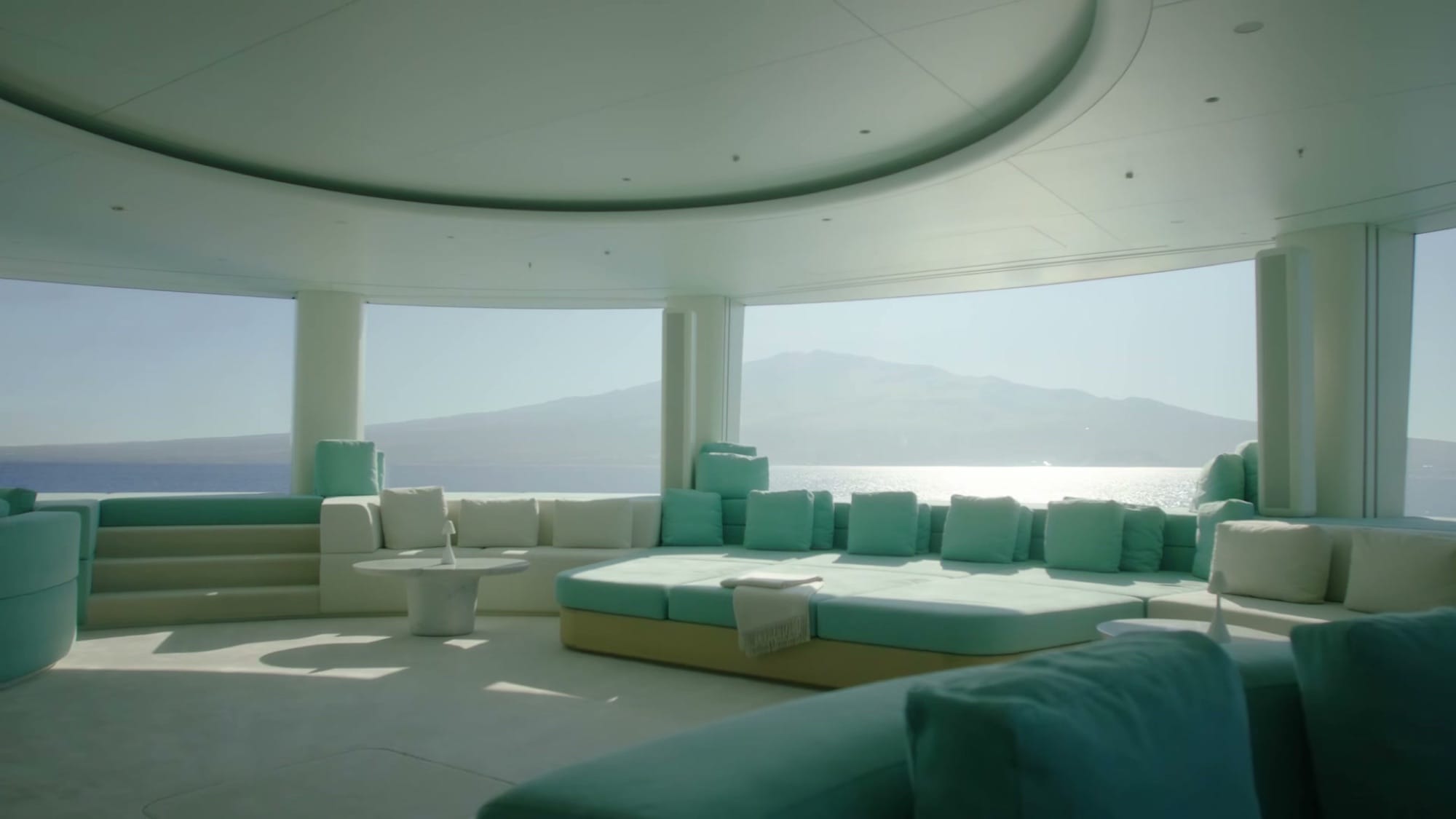
The same idea runs through the decks below. In the gallery, the glass runs from the ceiling down to the floor, so from inside the room the sea reads as an extension of the floor. At the bow, in the observation lounge, the panes are not flat: they curve with the round front of the room and give what Maezawa calls "almost 180 to 200 degrees of incredible ocean views." Bending glass that large to a curve, without the distortion he describes upstairs, is an accomplishment of its own. Even the gym, he says, "feels like an extension of the ocean."
What is inside Nausicaä?
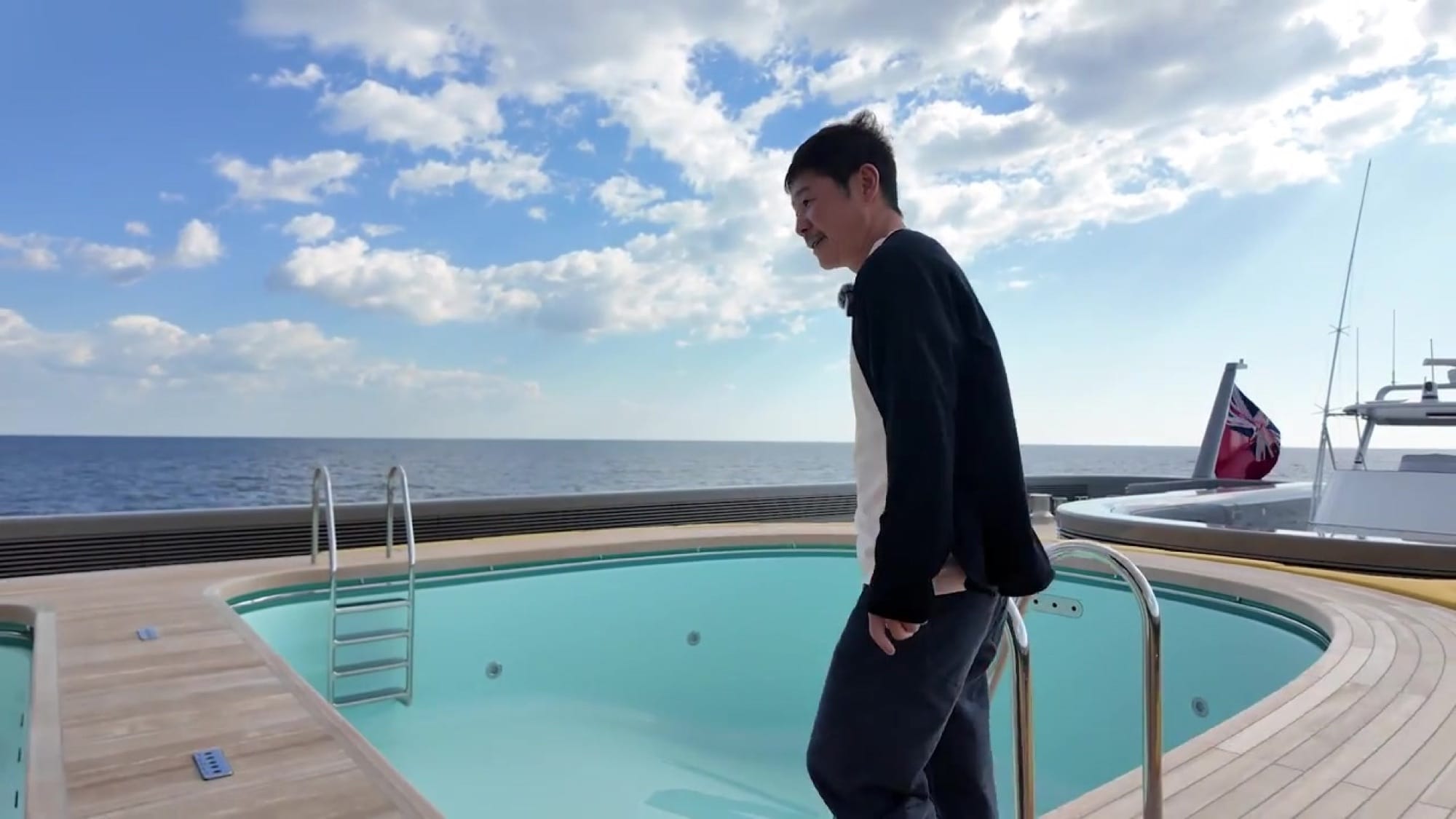
Six levels, built around views of the water. Maezawa walks through the following on the tour:
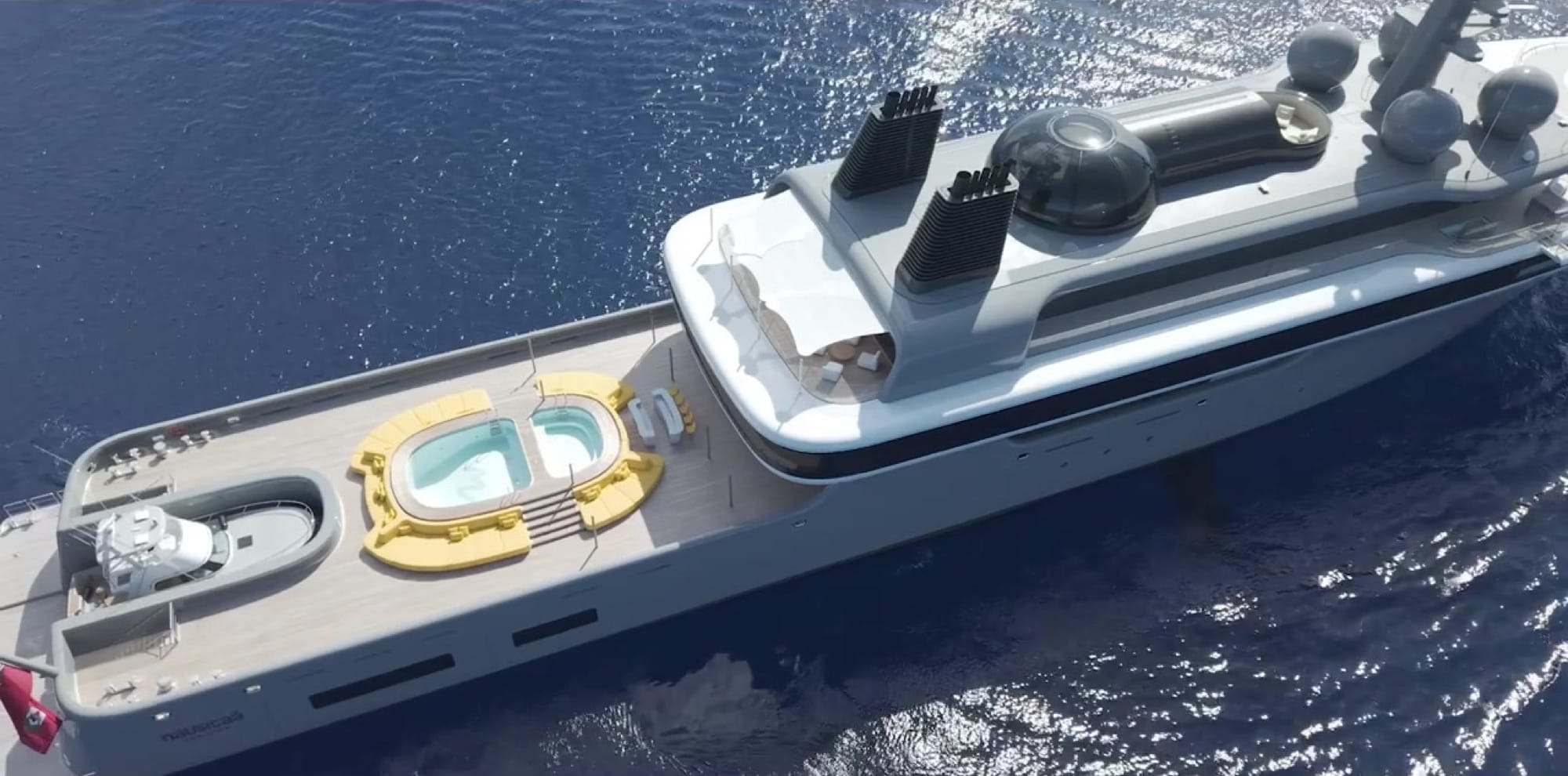
- A pool 1.8 to 1.9 meters deep with a counter-current, and a jacuzzi that fits about 20 people.
- A golf room, a Japanese bath that opens to the sea, two saunas and a spa room, covered in the next section.
- A study under the glass dome, which Maezawa uses as his office.
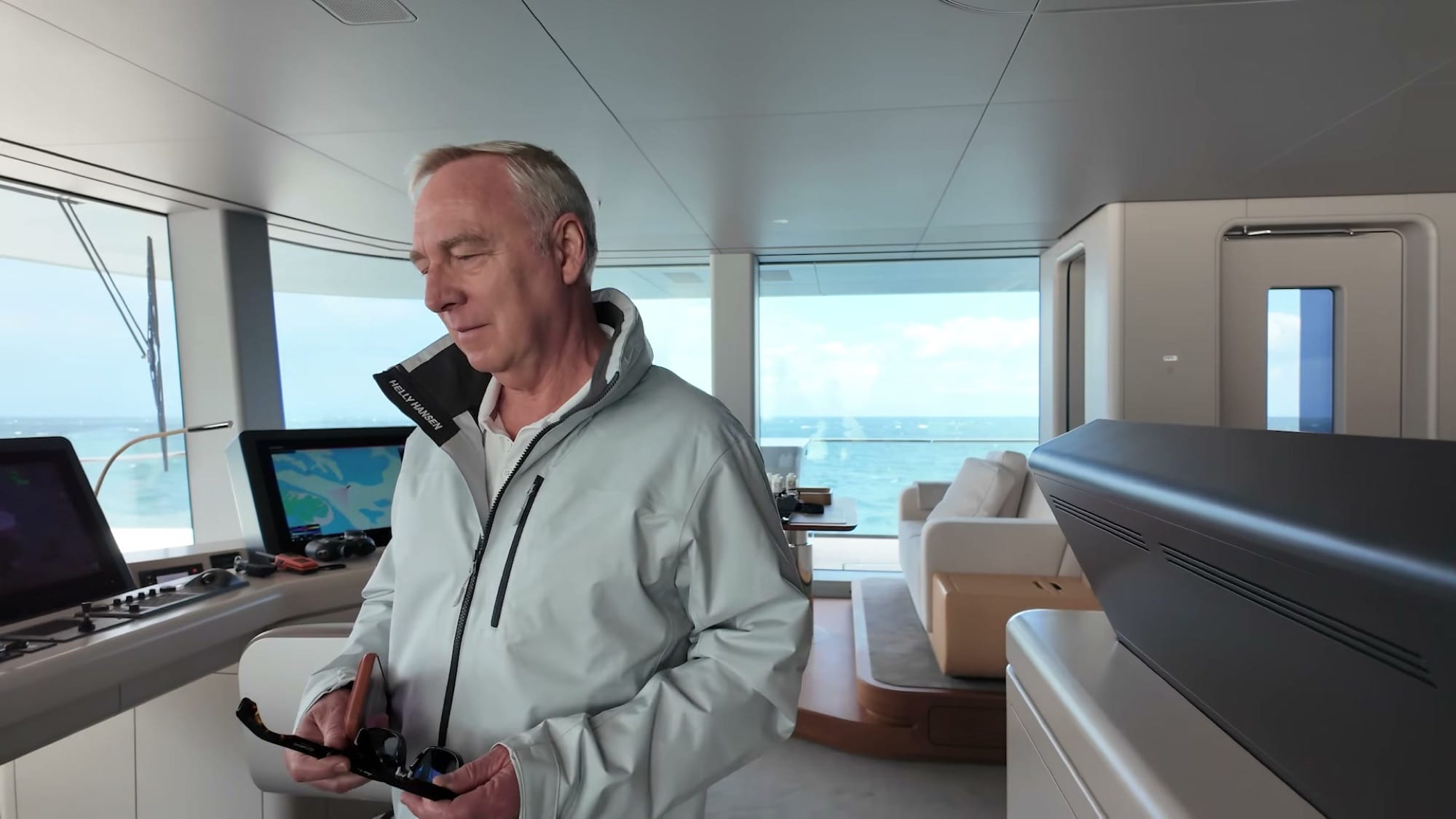
- A bridge run by Captain Claus, who Maezawa says has about 40 years in the industry.
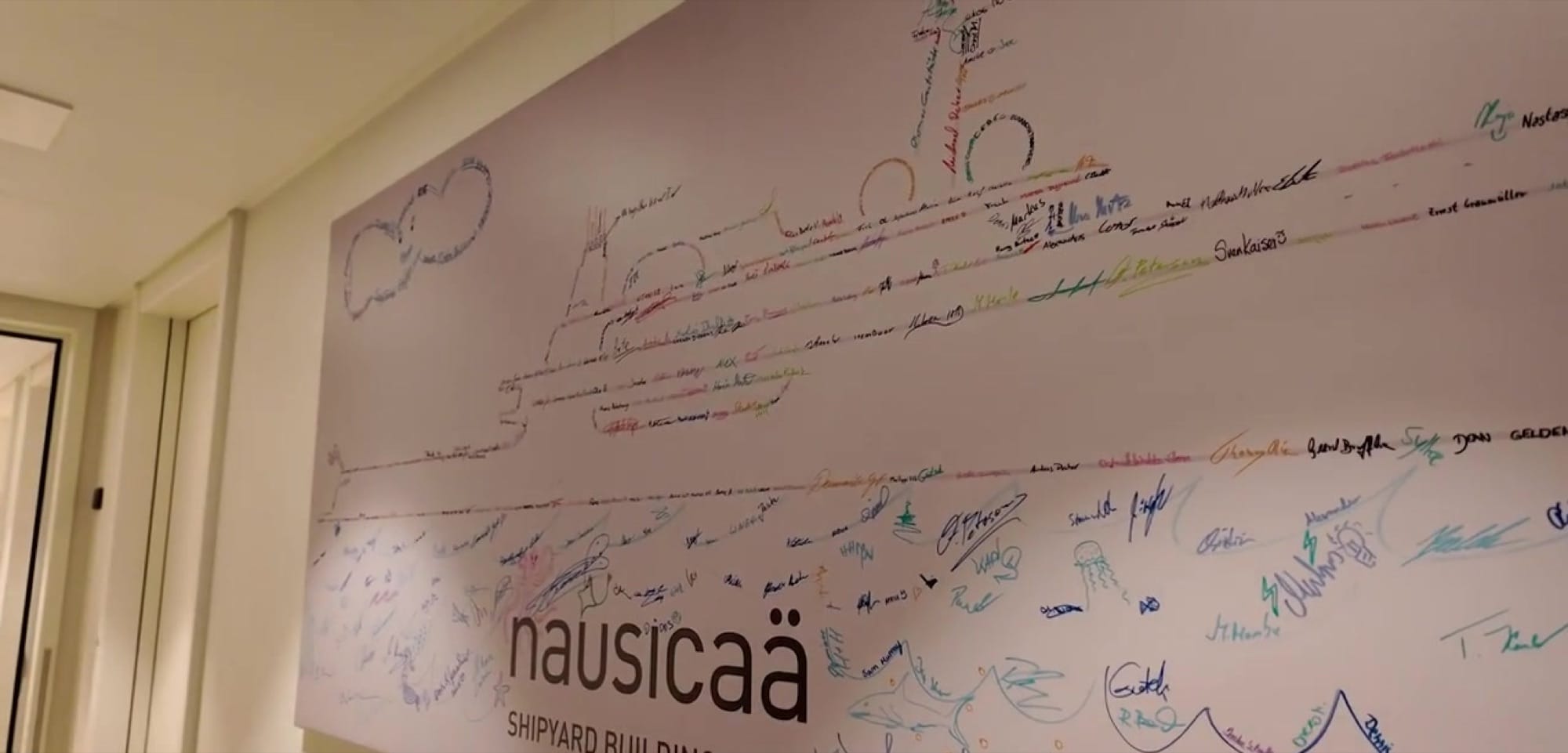
- Satellite domes, a helipad, a gym, a beach club and a wall signed by the shipyard team.
What can guests do on Nausicaä when the sea turns rough?
Plenty, by design. When the weather gets rough at sea, Maezawa says in the tour, you cannot go ashore or go anywhere. "So onboard activities really matter." These are the spaces he shows for those days.
A golf room. On the main deck, a dark room holds a TrackMan golf simulator, with a large screen, a strip of artificial turf and bags of clubs. Maezawa, who is left-handed, takes a few swings for the camera and says he played until about 2 a.m. the night before. "This golf simulator is one of them," he says of the things to do when the yacht cannot go anywhere.

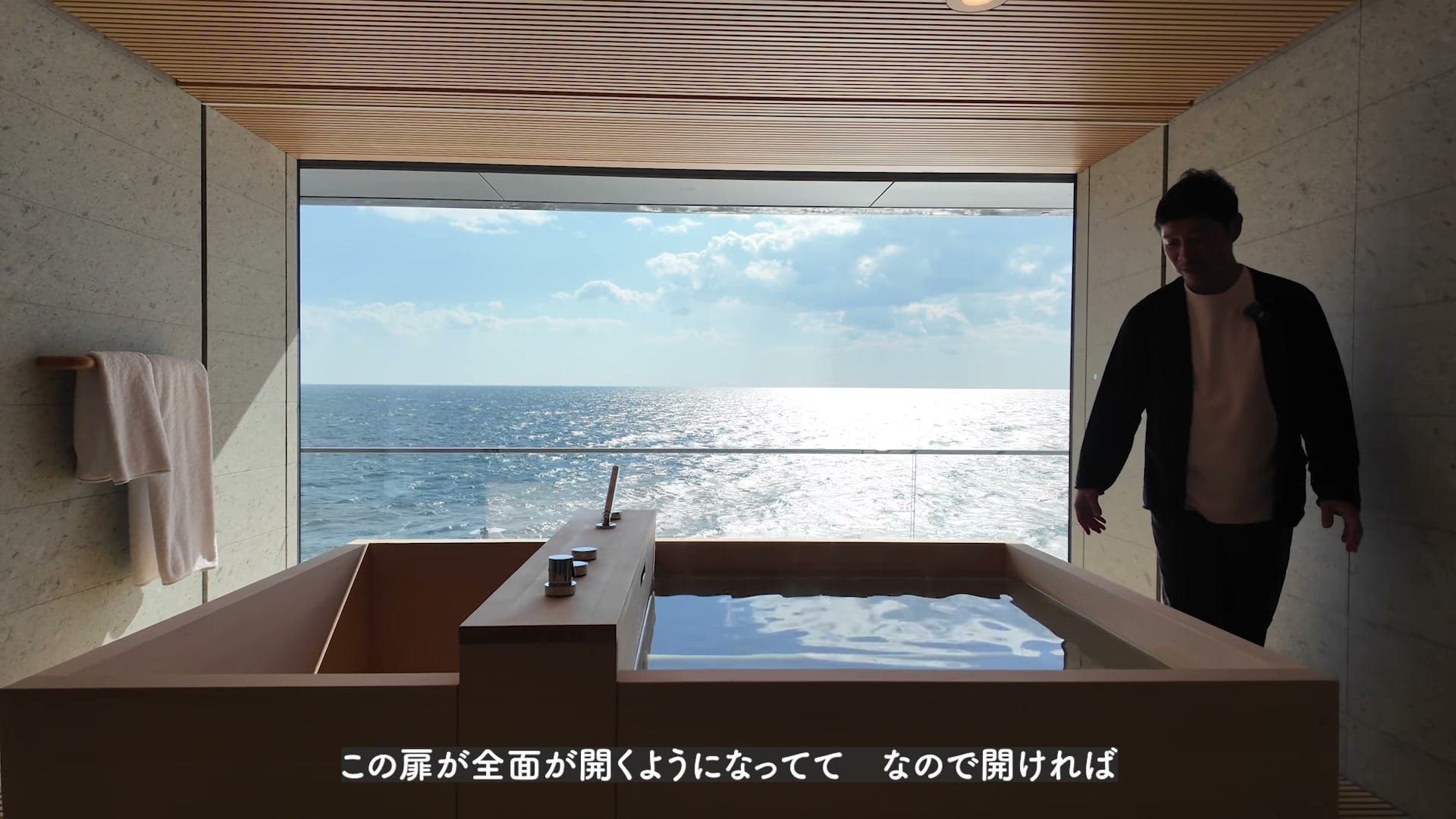
A Japanese bath that opens to the sea. The bath area works like a private onsen. The tub is Japanese hinoki cypress, the walls are Towada stone from the Lake Towada area in Aomori, and a cold plunge sits next to the hot bath. The surprise, Maezawa says, is that "this whole wall opens up." "These doors open all the way across. So it instantly becomes an open-air bath." He used it that way the night before and again that morning. It is not a hot spring, he points out: the yacht makes its own fresh water from seawater, and he believes the bath water comes from that system too. His idea of the perfect soak is Antarctica: "Minus 20 degrees outside. Forty degrees in the bath."
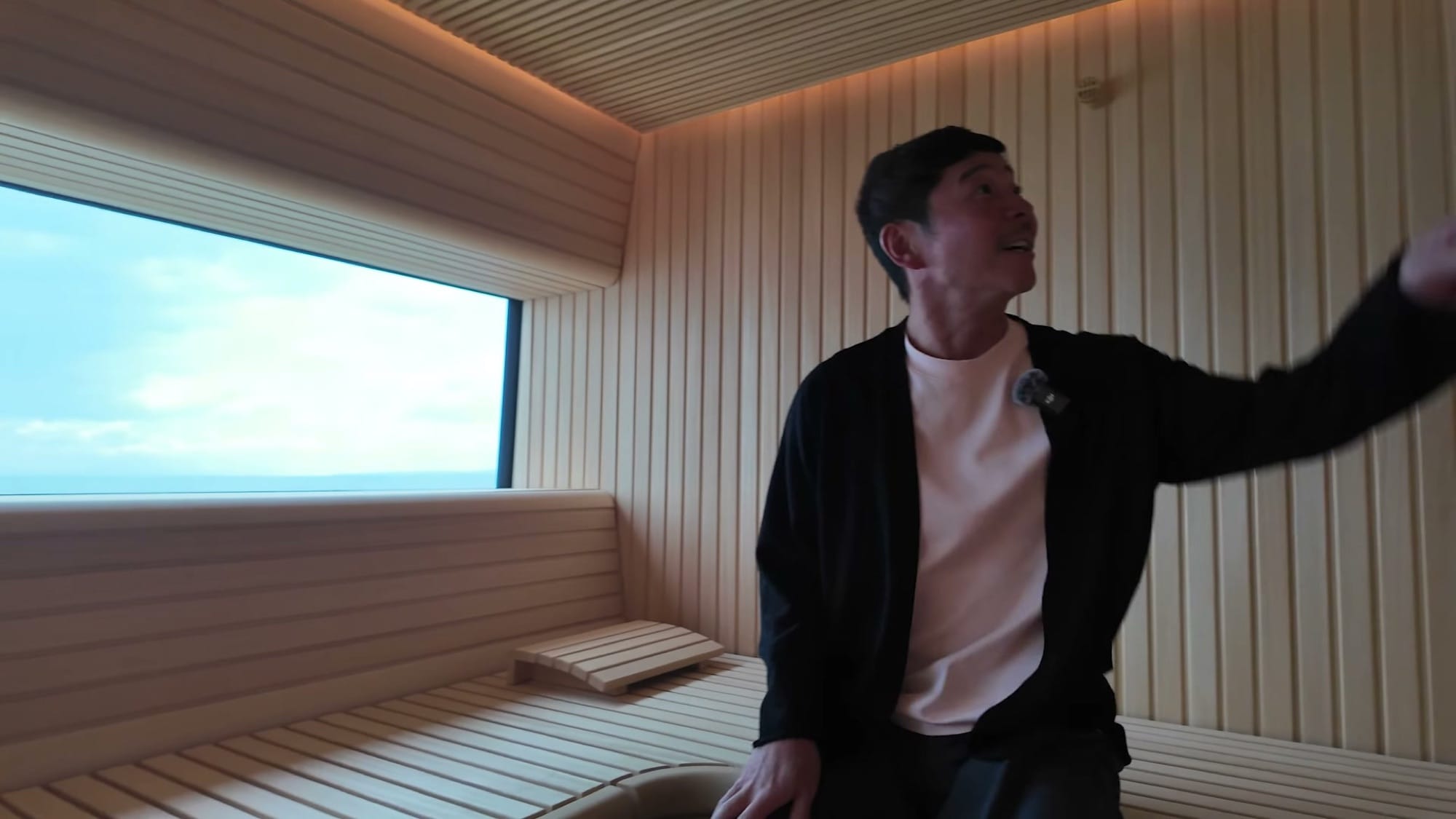
Two saunas. Next to the bath is a sauna for seven or eight people, kept at around 80 to 90 degrees Celsius, where you can pour water on the hot stones. The second, larger sauna is in the beach club. Maezawa says it fits 12 or more, and on the tour it reads about 88 degrees. The idea there, he says, is to warm up in the sauna and then jump into the cold sea in place of a cold plunge.
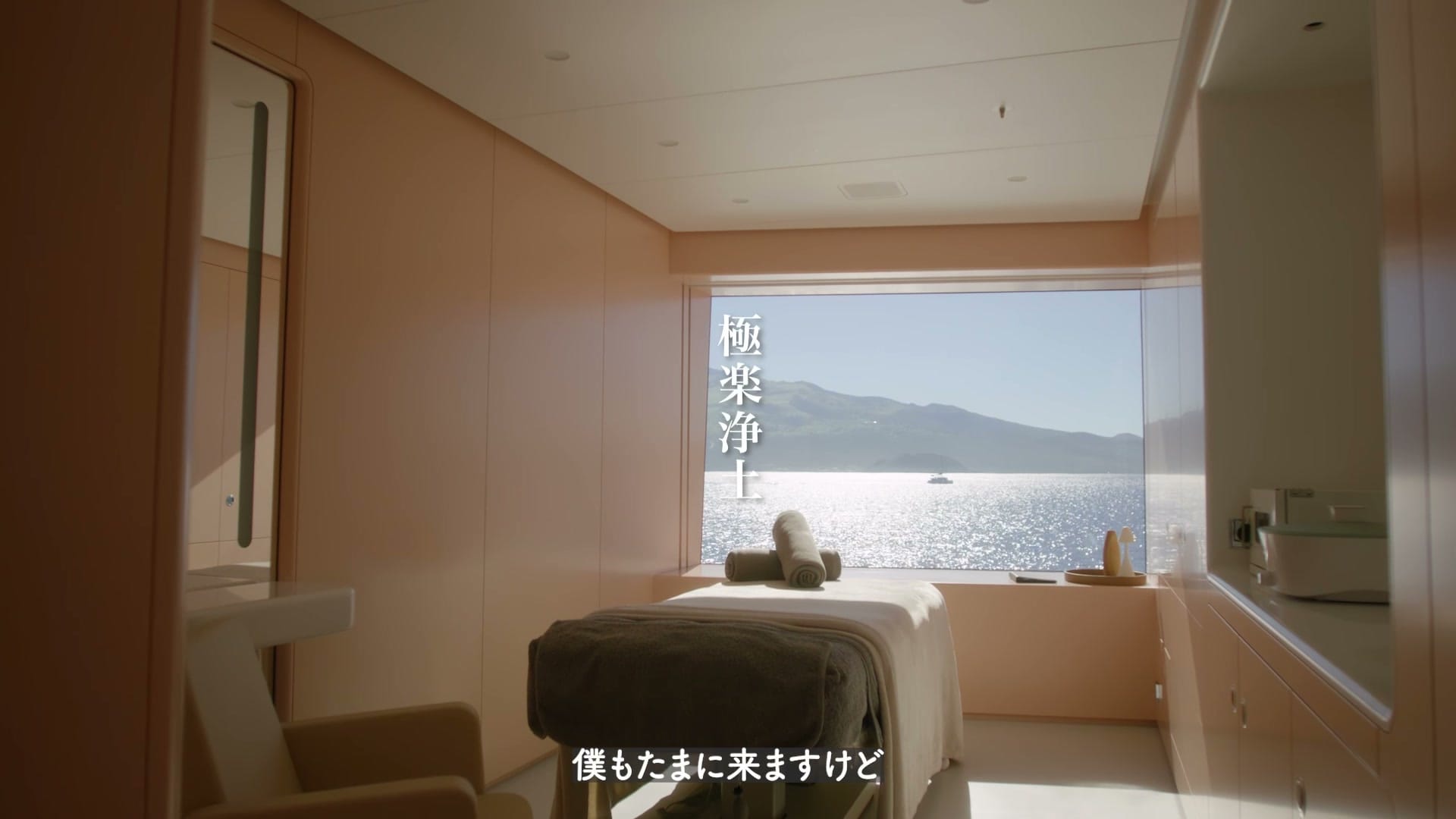
A spa room for massage and hair. Near the guest suites is a spa room with a massage bed facing a wide window onto the sea, a salon chair and a hair-washing basin. "You can even get your hair cut here," Maezawa says. "They can do hair coloring and all kinds of treatments." Guests can use it, and he comes in now and then, though he has not had a haircut there yet. The room is meant for longer trips, he says: "Imagine getting a massage while looking out at the ocean."
Does Nausicaä carry a submarine?
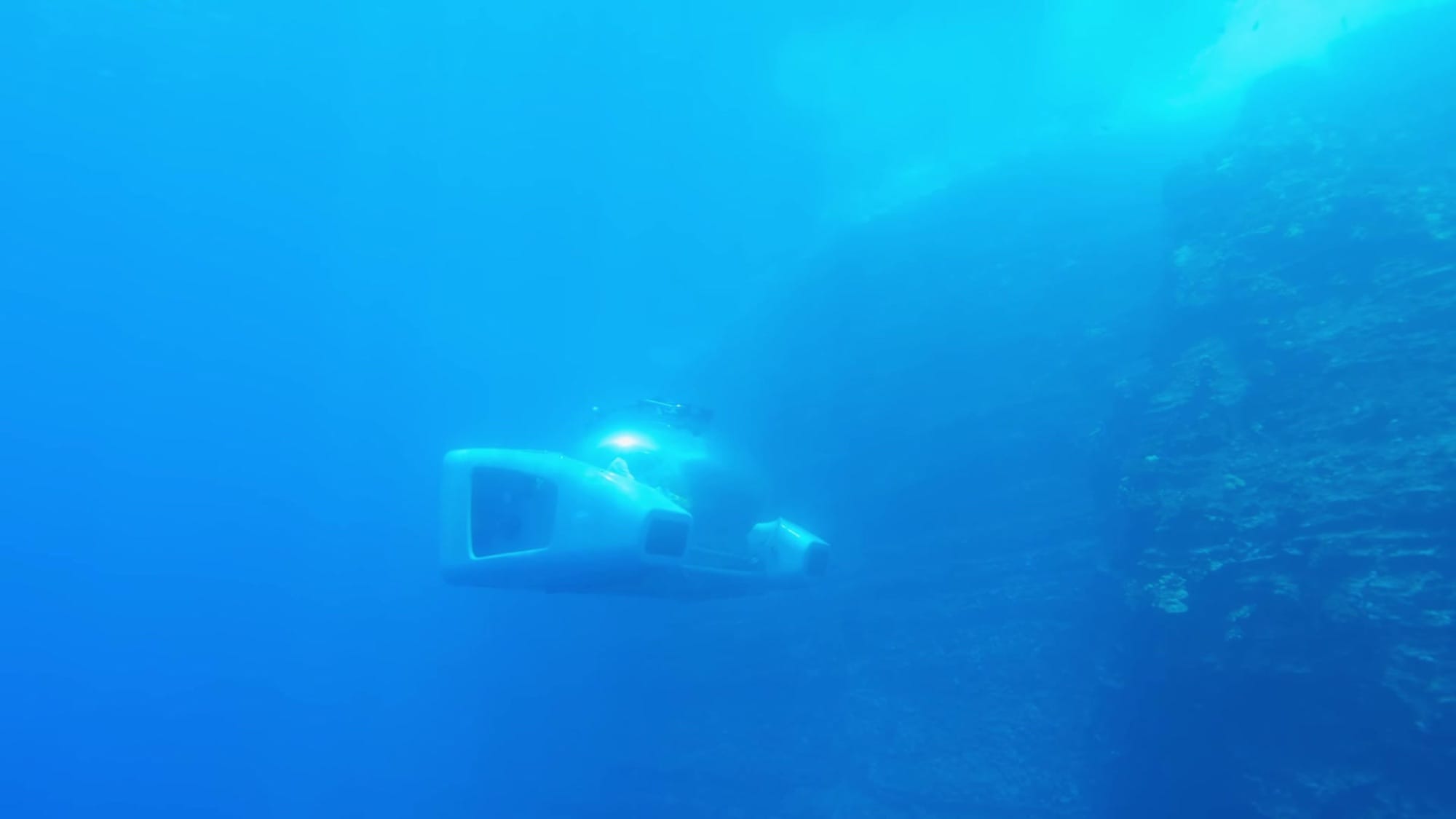
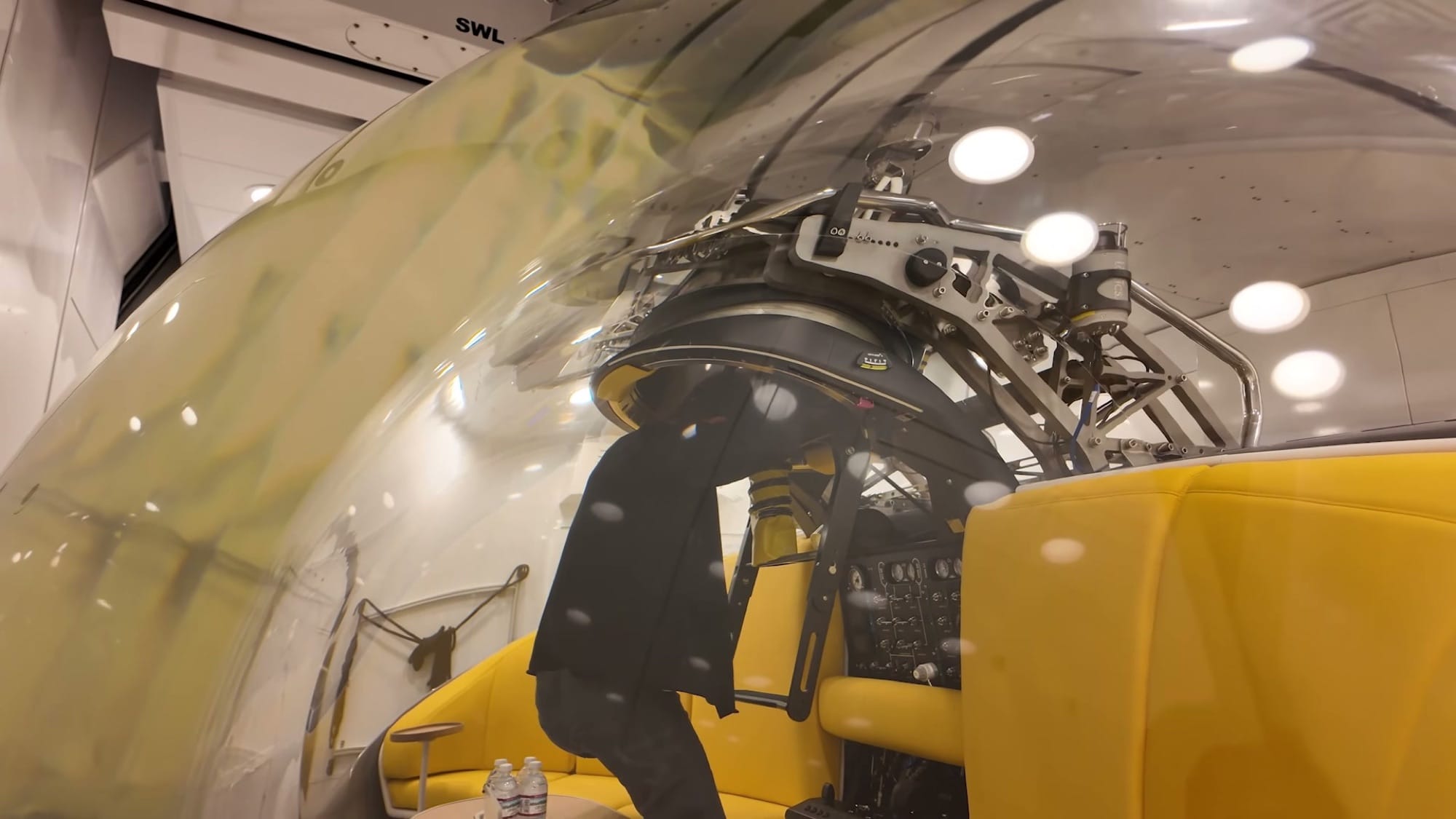
Yes. Maezawa says the submarine dives to 200 meters (656 ft), carries up to nine people and cost about 2 billion yen. Its passenger sphere is acrylic, not glass, and the seats inside are a bright yellow.
How does Nausicaä run?
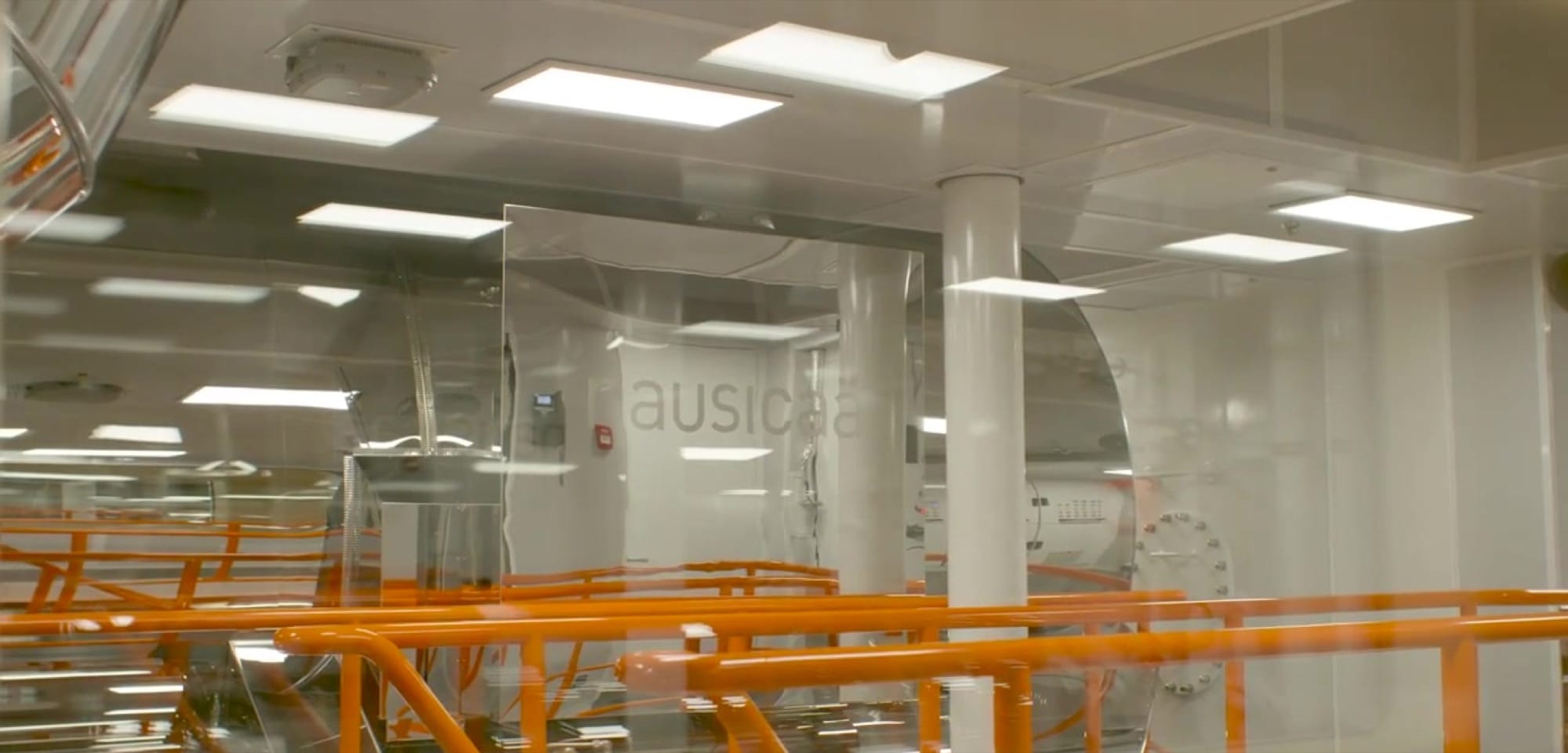
On diesel-electric power, with two main and three auxiliary generators driving electric azimuth pods. The engine room overlay in Maezawa's video lists two MTU 20V 4000 M53B main generators at 2,864 kWe each and three MTU 16V 2000 M41B auxiliary sets at 872 kWe each. The same overlay gives fuel use of about 22,000 liters (5,800 US gal) a day at a 13 knot cruise, about 42,000 liters a day at top speed, and capacity of about 600,000 liters (158,500 US gal). BOAT International adds a battery bank of up to 2 MW and Ice Class 1D, which answers Maezawa's third request: a yacht that can head for the ice.
What does it cost to own a yacht like this?
More than the build. Maezawa puts the build cost at 70 billion yen, or 400 million euros, and says lower figures in circulation are wrong. He adds that maintenance "costs a fortune too," with 30 to 40 crew living on board full time while the yacht moves between ports. He expects to use it one or two months a year and says charter is under consideration.
Which Lürssen and superyachts are for sale on YachtWay now?
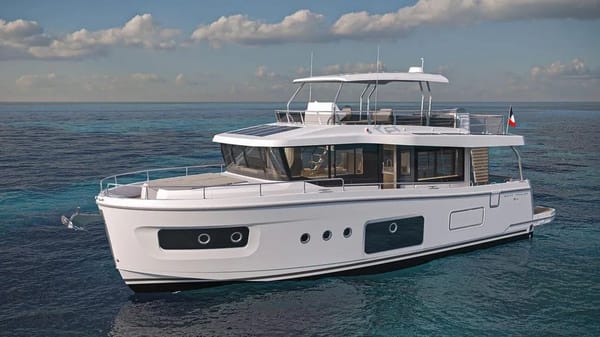
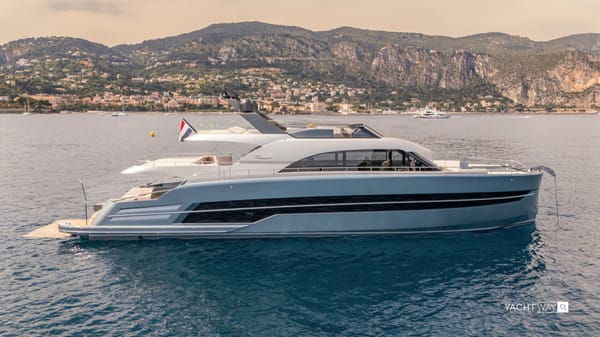
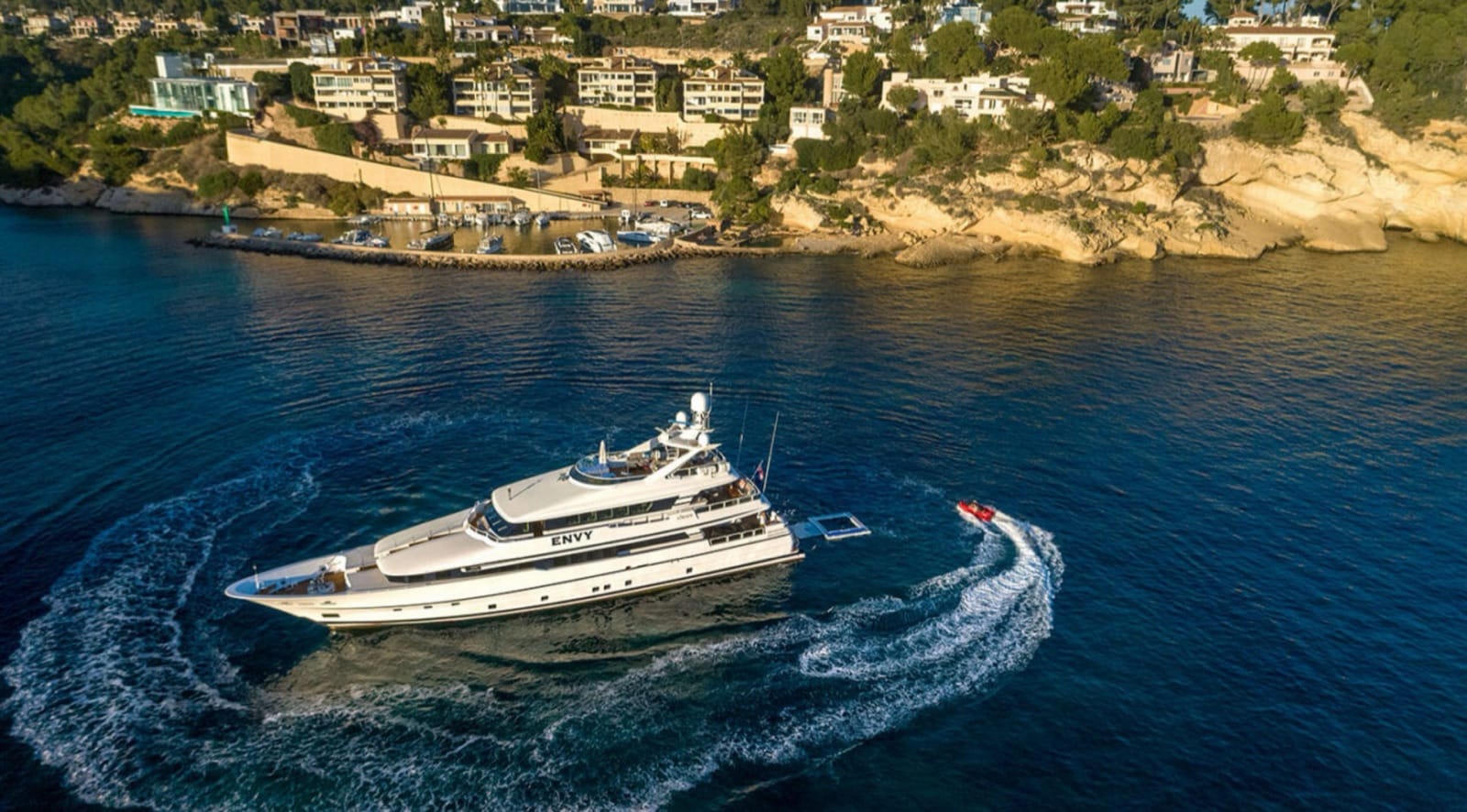
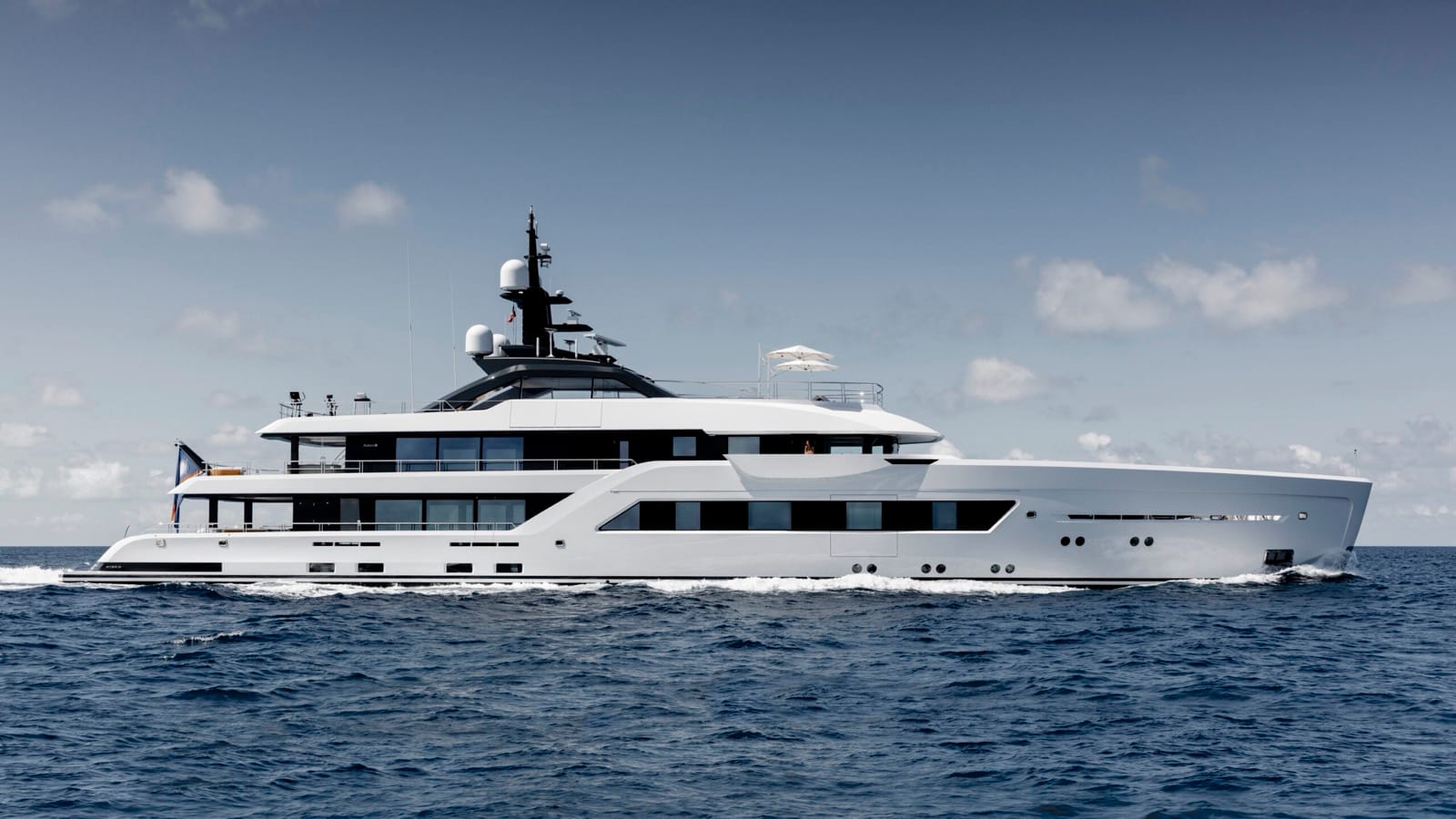
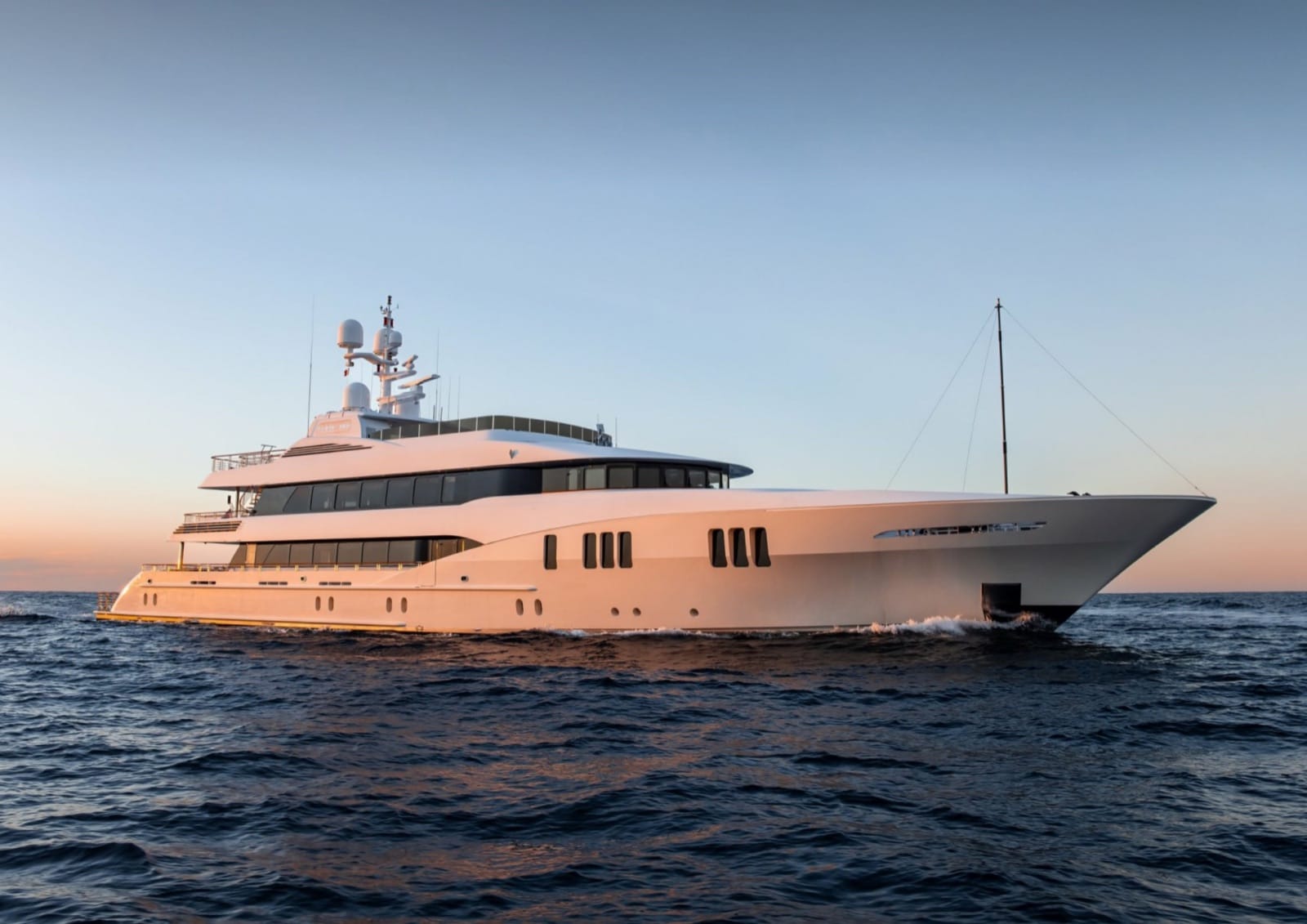
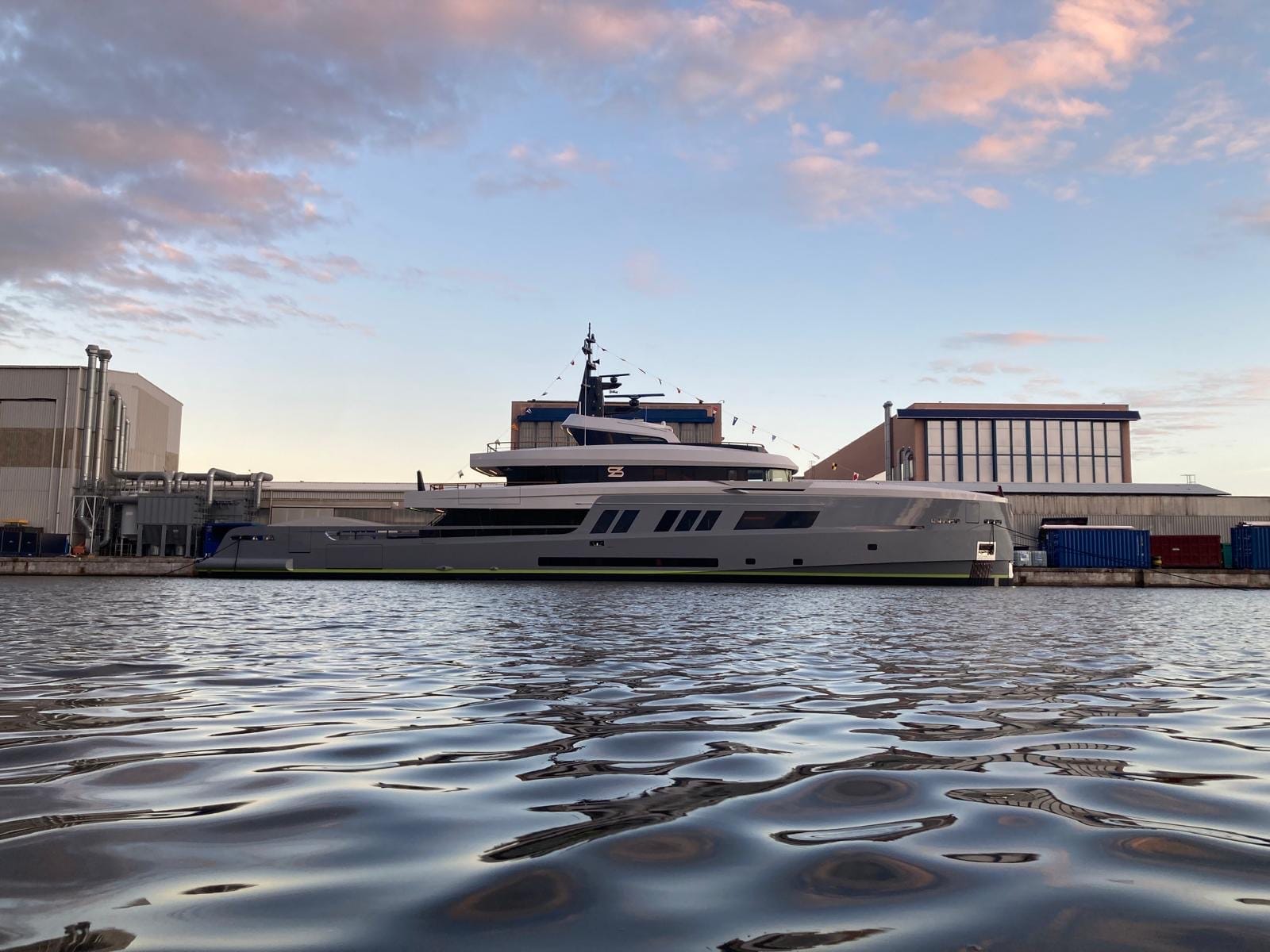
No yacht of 100 meters (328 ft) or more was listed on YachtWay on November 23, 2026. These four were, including a Lürssen. Browse every superyacht for sale or every Lürssen for sale, and book a tour, in person or virtual, from any listing.
What is the lesson for owners?
Design for the person you will be when the yacht is done. Maezawa ends the tour with the thought that about 70 percent of the Earth is ocean, and that he has seen almost none of it. He set out at 37 or 38 to build the boat that would take him there, and waited 12 to 13 years for it. That is Courage on the diving board: the jump takes a second, the decision takes years.
At every size, the same rule holds. Picture how you will actually use the boat in five or ten years, then buy or build for that. You can browse yachts for sale on YachtWay and book a tour, in person or virtual, from any listing. For more on this yacht's design, read Nausicaa by Marc Newson.
Watch the full tour: Yusaku Maezawa's Nausicaä room tour on YouTube.
Nausicaä yacht FAQ
Who owns the yacht Nausicaä?
Japanese entrepreneur Yusaku Maezawa. He presented the yacht himself in a video tour on YouTube published on November 21, 2026.
Who built and designed Nausicaä?
Lürssen built Nausicaä in Germany. Marc Newson designed it. Maezawa chose the materials, colors and art.
How long is Nausicaä?
114.2 meters, about 375 feet, according to Maezawa.
How long did Nausicaä take to build?
About 12 to 13 years in total, according to Maezawa: around six years of planning and design, then around six years of construction at Lürssen. It was delivered in May 2026.
What is the sculpture in the Nausicaä gallery?
Courage by Elmgreen & Dragset, a boy on a diving board deciding whether to jump. It was made for the yacht and weighs about three tons.
How much did Nausicaä cost?
Maezawa says the build cost was 70 billion yen, which he puts at 400 million euros.
How many guests does Nausicaä carry?
Up to 18 guests overnight, with about 40 crew, according to Maezawa.
Does Nausicaä have a submarine?
Yes. Maezawa says it dives to 200 meters, carries up to nine people and cost about 2 billion yen.